
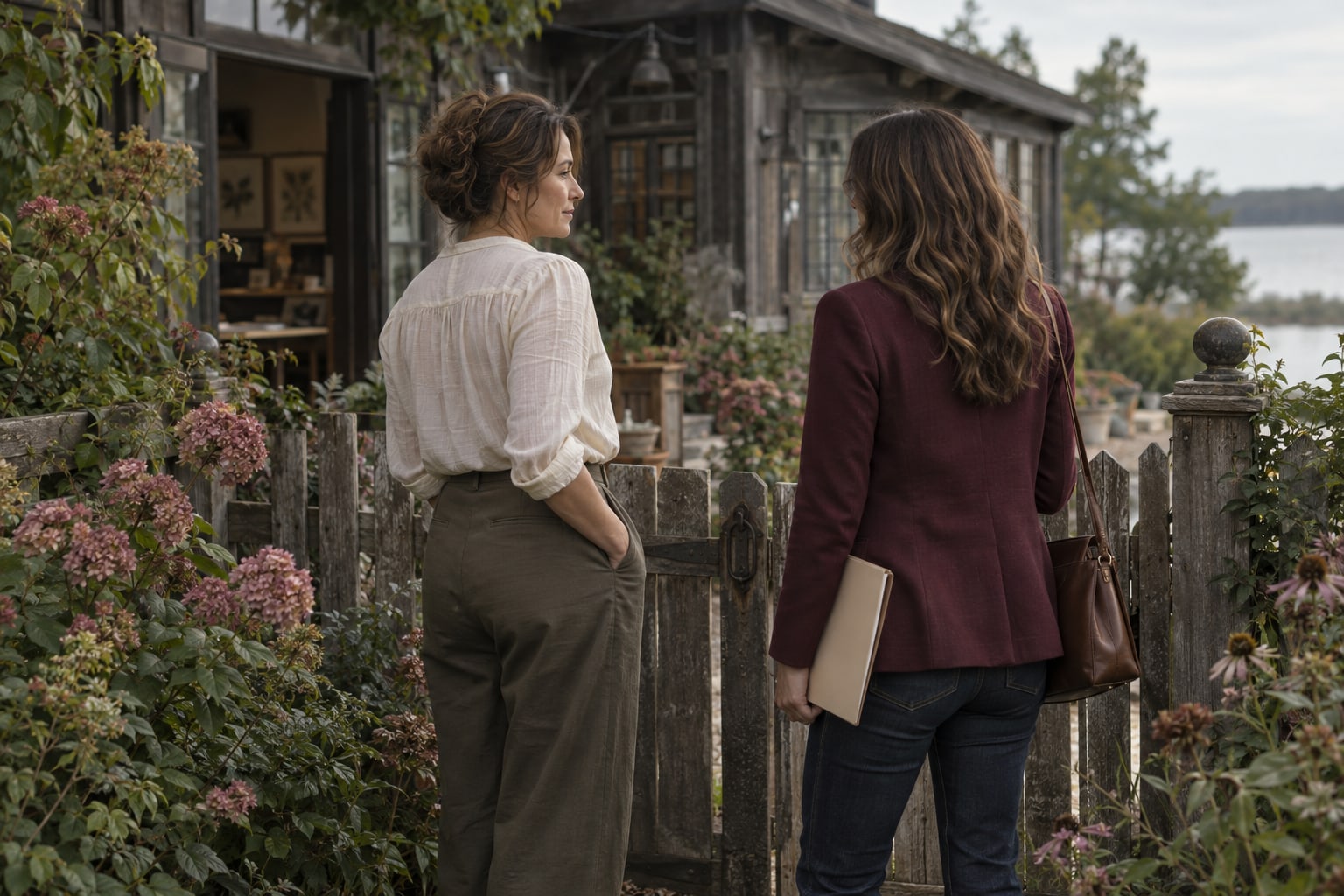
Mae Shaw arrived with a small overnight bag, a rolled tube of papers, and the expression of a woman prepared to leave if anyone called her grandmother difficult.
Nora recognized the expression because she had worn a version of it to her last meeting with her ex-husband’s accountant.
“Thank you for coming,” she said.
Mae glanced past her toward the print shop. “I was visiting friends in Grand Rapids. This isn’t as dramatic a journey as everyone seems to think.”
“Then thank you for the detour.”
That earned the smallest smile.
They sat at the kitchen table first. Nora had resisted baking something elaborate, which would have been both transparent and beyond her abilities. There was coffee, good bread from Priya, and June’s letter in the middle of the table.
Mae was thirty-five, an occupational therapist who worked with adults recovering from serious injuries. Her mother had died in April. She had been sorting a house, handling two estates’ worth of forgotten details, and continuing to turn up for people whose lives had changed without permission.
“I don’t have a romantic attachment to a building I visited twice,” Mae said. “I do have an attachment to knowing what belonged to my grandmother.”
“That makes sense.”
“You would be surprised how often people explain that it shouldn’t.”
Nora showed her the corrected copy of the newspaper photograph. Mae touched Celia’s face with one fingertip.
“She hated that shirt. Said it made her look like a sofa.”
“It’s the first thing I remember about her.”
“The sofa?”
“The colors. And her rings. She taught me that a red room didn’t have to shout.”
Mae’s shoulders lowered slightly. “That sounds like her.”
They read June’s letter together. Mae unrolled a copy of an older agreement, then set it aside before Nora could struggle through the faded legal language.
“The lawyers can deal with that. This is what I wanted you to see.”
She unfolded a letter in Celia’s handwriting. In it, Celia asked about returning for six weeks the following summer, using the print shop, and exhibiting new work. She wanted her name restored to the sign and the public class notices. There was nothing angry in the letter. Its restraint made it worse.
“Did June answer?” Nora asked.
“She said the shop was cluttered and the timing was difficult. They exchanged birthday cards afterward. They were still fond of each other. That doesn’t mean this stopped hurting.”
Nora looked toward the annex door. She loved her aunt. She also understood, with a painful clarity, how easy it was for a capable, beloved person to let everyone use the version of a story that flattered her.
“I’m sorry,” Nora said. “I can’t apologize on June’s behalf. But I’m sorry you had to come here prepared to prove it.”
Mae looked at her fully for the first time. “Thank you.”
In the print shop they stayed on the sound section of floor. Eli had put down a temporary boundary using freestanding markers, at Nora’s request, and labeled the unsafe area in handwriting so legible it looked printed.
“Your contractor?” Mae asked.
“I’m considering his estimate. Also my neighbor.”
Mae studied Nora’s face briefly but did not comment.
The mural stopped her. She walked toward it slowly and set down her bag.
“That’s my grandmother’s scarf,” she said. “The one on the woman with the paper. I still have it.”
Nora had mistaken the painted scarf for June’s. She felt heat rise in her cheeks, a tiny example of the larger habit she had just discovered.
“I thought that was June.”
“June is the one holding the door. Look at the earrings.”
Of course. June’s extravagant brass moons. Nora stepped back and let the women become themselves.
Mae photographed the mural, the press, and the shelves. In a drawer they found block-print tools wrapped in a towel embroidered with a C. Nora handed the bundle over without hesitation.
“We should record what we find,” she said. “But if those are hers, they should go with you.”
Mae held the tools against her palms. “I thought this would all be gone.”
“I don’t know what’s in half the drawers.”
“Then don’t throw anything out yet.”
“I won’t.”
They returned to the kitchen for more coffee. The property company’s offer sat beneath Nora’s notebook. She brought it out because leaving it hidden would change the character of the conversation.
Mae examined the sketch of vacation cottages. “They contacted me, too. Not about the whole property. About whether I would sell my interest.”
“Would you?”
“Possibly. I’m not here to punish a house. I have obligations, and I don’t want an expensive sentimental project several hours from home.”
Nora nodded, although disappointment moved through her. “I want to make the duplex a home and studio. I’d like the shop to be part of that eventually. But I can’t promise a buyout until I know what the repairs cost.”
“Then we find out,” Mae said. “No one needs to promise me a dream by lunch.”
After Mae left to check into a small inn, Nora found Eli in his driveway sharpening a chisel. He set it down when she approached.
“How did it go?”
“She’s reasonable. Which is inconvenient. It’s easier to defend yourself against unreasonable people.”
He leaned against the workbench. “Do you need defending?”
Nora considered the question. “No. I need to make a plan that includes someone whose life isn’t arranged around mine.”
“That sounds harder.”
“Thank you for resisting an inspirational answer.”
He smiled, and she felt the release of being with someone she did not have to impress. His workshop smelled of cedar. In the corner stood a small chair with its seat removed, each part carefully tagged. A radio played low enough to be almost private.
“Could I just stand here for a minute?” she asked.
“You can sit. That chair’s finished.”
She chose the stool beside the workbench instead. Eli returned to sharpening, explaining the angle only when she asked. Watching him work steadied her. He did one thing at a time and paid attention to it, a quality she found more compelling than she wished to examine.
“I accepted your estimate,” she said after a while.
His hand stopped. “You got the second one?”
“Yes. Yours wasn’t the cheapest. You understood the room.”
He looked pleased in a quiet, unguarded way.
“I’ll send the contract tomorrow.”
Nora slid off the stool. At the doorway she turned back. “And Eli? When we walk to the lake, that’s not a client meeting.”
“I know.”
“Good.”
He held her gaze. “I was hoping you did.”
She crossed her garden smiling, then stopped at the kitchen table. Her phone displayed a message from Mae.
I found one more letter. June promised Celia the first exhibition when the shop reopened. It never happened. Before we decide anything, I want you to know what that promise was.