
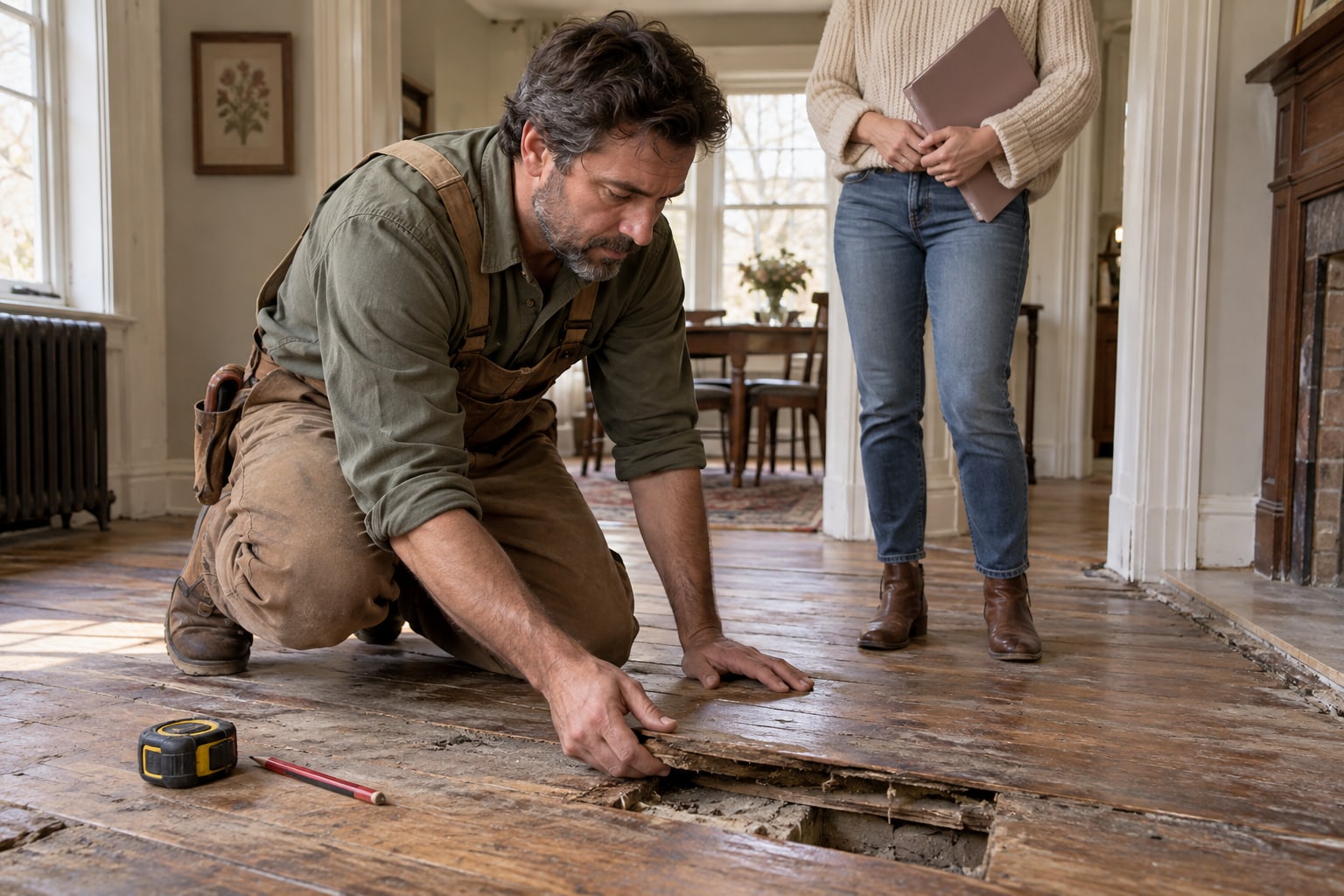
The engineer wore muddy boots, carried a small flashlight, and had the merciful habit of saying what he meant.
“The duplex is stable,” he told Nora. “This section needs repair before people use the back exit. The annex floor needs more extensive work. Those are related moisture problems, but they are separate scopes.”
Nora stood in the kitchen with her notebook open. Eli stood beside the doorway, allowing the engineer to explain his own findings.
The old flashing where the annex met the duplex had let water into the wall for years. Repairing the wall and landing would cost money she had assigned to worktables, lighting, and a sink. The annex required more investigation before either owner could responsibly approve a restoration plan.
“Can I open the front room for a small gathering?” she asked.
“Ask the local building official about occupancy and exits once this repair plan is submitted. Until then, I wouldn’t invite a group in.”
He showed her photographs, answered her questions, and left her with facts she wished were less useful.
After his truck pulled away, Nora looked at Eli. “You said the right side was sound.”
His expression changed, but his voice remained level. “The visible framing was. This was behind the wall. My estimate explained what we couldn’t see.”
“I read it.”
“I know.”
“I told people they could come.”
“We can change the plan.”
“Everyone says that as if plans aren’t made out of actual money.”
The room went quiet. Eli put his pencil down.
“I understand you’re upset. I can go through the costs when you’re ready. I’m not going to defend stopping work around damage we need to repair.”
Nora felt the immediate, hot impulse to argue. Beneath it was fear: that she had mistaken longing for competence, that the house would consume her savings, that everyone would watch her fail in a town where people remembered her as a little girl.
None of that was Eli’s fault.
She gripped the edge of her notebook. “You’re right. I’m sorry. I’m frightened, and I aimed it at you.”
He took a breath. “Thank you for saying that.”
“I need half an hour before I discuss numbers.”
“Take it.”
He left for his workshop. He did not stay to earn forgiveness for a mistake he had not made. Nora found that boundary both uncomfortable and deeply reassuring.
She called Priya, who arrived with a broom because she had heard “water damage” and assumed there would at least be something practical to hit with cleaning equipment.
Instead, they sat on the front steps.
“I was sharp with him,” Nora admitted.
“Did you apologize?”
“Yes.”
“Did you mean it?”
“Yes.”
Priya nodded. “Then let the apology do its work. Don’t make him comfort you about having been unkind to him.”
Nora considered that. “You charge too little for soup.”
“I know.”
They moved the September gathering to the café’s back room. The room was smaller, which made the invitation feel like a conversation rather than an opening. Nora would print photographs of the duplex and ask visitors what hours, equipment, and prices would make a studio useful.
“You haven’t broken a promise,” Priya said. “You’ve changed the address.”
By noon, Nora was ready for numbers. She found Eli sanding a length of trim in his garage.
“I’d like to talk about the wall repair,” she said. “And I’d still like dinner tonight, if you would.”
He set the sander down. “I would. Those can be two different conversations.”
They revised the work schedule at her kitchen table. Nora postponed built-in storage and chose secondhand tables. Eli explained where she could safely do preparation herself and where a licensed professional was necessary. The repair would be a written change to the contract, priced before it began.
Nora drew a line through the expensive shelving in her notebook. To her surprise, the smaller version of the room still looked like her own idea. Losing a feature did not mean losing the reason she had wanted it. She turned the page toward Eli and pointed to the empty corner by the window. The quiet chair could stay.
“No heroic discounts,” she said.
“Wasn’t planning one.”
“Good.”
His mouth curved. “You look disappointed.”
“I contain several departments. We discussed this.”
At six-thirty, she crossed the driveway wearing a navy dress and carrying a bowl of pears she had bought partly as a joke. Eli opened his door in a clean blue shirt. For a second they simply looked at each other.
“Hello,” he said, differently from the way he said it over a workbench.
“Hello.”
His house was small and comfortable. Books stood beside a ceramic bowl full of screws. A landscape painted by his father hung above the sofa. The kitchen smelled of roasted chicken and rosemary.
“I was going to cook something more ambitious,” he said. “Then I remembered I wanted to talk to you.”
“A wise menu decision.”
They ate at a round table beside the window. Nora told him about a hotel executive who had described a drawing as “too emotionally curved.” Eli told her about restoring a staircase for a woman who measured his progress with homemade cookies and increasingly direct opinions.
They laughed without discussing joists for nearly an hour.
After dinner, Eli asked whether she minded music. She chose a record from a shelf containing far more blues than she expected. He put it on, and they washed the dishes together because Nora wanted to stay in the kitchen with him, not because she felt obliged to be useful.
When she handed him the last plate, their fingers touched.
He set the plate down carefully. “Nora.”
She looked up. His face held a question he was not going to disguise.
“May I kiss you?”
“Yes.”
He leaned toward her slowly enough that she had time to meet him halfway. The kiss was warm and gentle. It contained no demand to become something larger before she was ready.
When they drew apart, she rested a hand against his chest for a moment, feeling the ordinary solidity of a person standing with her.
“I’ve been thinking about that,” she admitted.
“So have I.”
They stood smiling in his kitchen like people who had discovered something both simple and surprising.
Later, he walked her to her porch. He did not ask to come inside. She kissed him once more because she wanted to, then watched him cross the garden path.
The house still needed an expensive repair. The shop still belonged partly to someone who might sell. Her life had not become easy while she ate dinner.
But when she opened her laptop, she found a message from Mae with a scanned page attached. Celia had kept a list of people who had helped build the print room.
Near the bottom was a familiar name: Daniel Mercer.
Beside it, in a different ink, Celia had written, Ask him about the door.