Adam's invitation came with enough information to qualify as a small event plan. Beth was having Sunday lunch. Her husband would grill vegetables. Their children would be present and loud. His parents would come for dessert. Lena could arrive late, leave early, or decline entirely.
She read the message to Marisol, who was trimming a poster with alarming precision.
“He's discovered context,” Marisol said.
“Should I go?”
Her friend looked up. “Do you want to?”
“I want to see Beth. I don't want to be presented as proof that everything has worked out.”
“Then give the invitation edges.”
Lena told Adam she would come for lunch and leave before dessert. She wanted Beth to know they were getting to know each other again, with nothing settled. He answered that he would tell her exactly that.
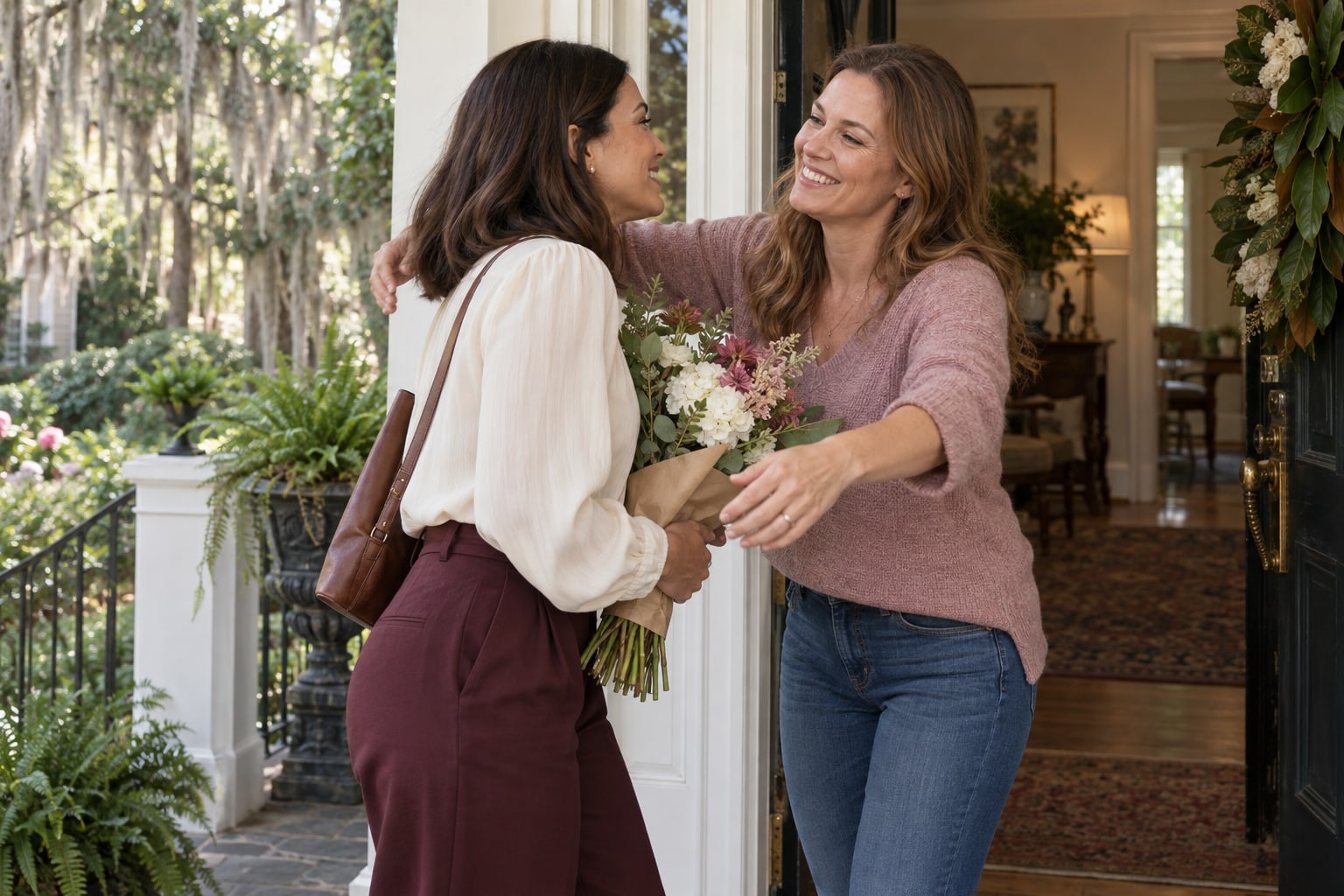
On Sunday, Lena arrived carrying flowers and the fragile confidence of a woman entering a house full of people who remembered her at nineteen.
Beth opened the door and hugged her once, firmly.
“I have a million questions,” she said. “I'm limiting myself to three, and none involve my brother.”
Lena exhaled. “I may stay forever.”
“That would make school pickup easier.”
Lunch was noisy and ordinary. Beth's son asked what an exhibition designer did, then proposed a museum where every label was a riddle. Her daughter wanted to know whether Lena owned a laser cutter. Adam sat across the table, answering questions about a broken birdhouse with the seriousness other people reserved for tax advice.
Lena liked seeing him belong to a family without managing every movement of it. When Beth asked him to fetch ice, he asked her husband where it was instead of searching all the cupboards in silent determination.
In the kitchen afterward, Beth handed Lena a towel.
“He told me about the letter,” she said.
Lena stopped drying the plate.
“Only what he did. Nothing you wrote. I wanted you to know I don't think there's a family explanation that makes it fine.”
“Thank you.”
Beth leaned against the counter. “We were all scared when Dad got sick. Adam turned himself into a piece of load-bearing furniture. We let him. That doesn't mean he had to treat you like something he could put away until life was easier.”
Lena looked toward the yard, where Adam was listening to the birdhouse proposal again.
“I don't want everyone to be on my side against him.”
“Good. I'm on the side of people speaking in complete sentences.”
Lena laughed.
“How are you?” Beth asked. “Apart from him.”
So Lena told her about Seattle. About declining the Chicago promotion on Friday. About how her supervisor had sounded disappointed and then, surprisingly, admitted the role would mean far less design work.
“Was saying no awful?” Beth asked.
“For fifteen minutes. Then I slept better than I have in months.”
Beth dried another plate and told Lena she had applied to direct a community choir. The rehearsal schedule would require her husband to handle bedtime twice a week, a detail she delivered as if anticipating an objection.
“Does he object?” Lena asked.
“No. He bought himself a book of better bedtime stories. Apparently his current material lacks range.”
“Then whose objection are you preparing for?”
Beth looked at her, then laughed. “Mine, apparently.”
They stood together in the kitchen, two women old enough to recognize how duty could borrow their own voices. Lena asked when the audition was. Beth told her, and Lena put the date in her phone. Some futures deserved witnesses before they had earned applause.
The doorbell rang earlier than expected.
Adam's mother entered with a cake carrier, followed by Richard using his cane. Margaret saw Lena and stopped so abruptly that Richard nearly bumped into her.
“Oh,” she said. “Oh, my goodness.”
Lena set down the towel.
Adam came in from the yard. “Mom, Lena's here for lunch. I told you we were spending some time together.”
“Of course.” Margaret put the cake on the table and took Lena's hands before either could consider the gesture. “Your father would be so happy to see you home.”
The room narrowed.
Lena gently withdrew her hands. “I'm here for the garden project.”
“Yes, darling. I just meant that sometimes things come right in the end.”
Richard looked down. Beth opened her mouth. Adam spoke first, carefully.
“Mom, Lena's life in Chicago isn't something that went wrong.”
Margaret flushed. “I didn't mean that.”
“I know. But she doesn't need us to decide what being here means.”
Lena felt relief, then the irritation of needing relief at all.
“I'm leaving for an appointment,” she said. “Thank you for lunch.”
Beth hugged her at the door. Adam walked her to the sidewalk and stopped before the car.
“I'm sorry,” he said.
“You didn't invite them early.”
“No. But I should have prepared her better.”
“You can't prepare every person in Savannah.”
He nodded. “That's true.”
She leaned against the car. “I don't want you correcting people while I stand there becoming a symbol.”
“Would you have preferred I let you answer?”
She considered. “Today, what you said helped. I just hate that it was necessary.”
“So do I.”
The honesty steadied her.
“I don't want my father recruited into a story he isn't here to approve,” she said.
Adam's face softened. “Neither do I.”
She looked at him, at the man standing in sunlight with a smear of charcoal on his sleeve. He had not solved the afternoon. He had stayed in it with her.
“Would you walk with me?” she asked.
They left her car and followed the block toward a small square. She told him about the first question in her Seattle interview, how the panel had asked why gardens mattered to people who did not garden. He asked what she had said.
“That making a place and belonging to it aren't the same thing. Visitors deserve both possibilities.”
He smiled. “I'd have given you the residency on that answer.”
“You weren't on the panel.”
“A serious oversight.”
At the corner, a delivery cyclist passed too close. Adam moved aside but did not pull her with him. Lena reached for his hand after the cyclist had gone, when the gesture could belong entirely to her.
He looked down, then at her.
“This all right?” she asked.
“Very.”
His hand was warm and familiar in dimensions she had no interest in explaining. They walked the next block slowly. Nobody asked them where they were going.
That night, Margaret sent a message through Adam asking whether Lena would be willing to receive an apology directly. Lena said yes. The message that followed was simple: I made assumptions about your life. I'm sorry. I would like to know the life you actually have, if you ever want to tell me.
Lena did not answer immediately. She saved the message, put the phone down, and allowed an invitation to remain an invitation.