
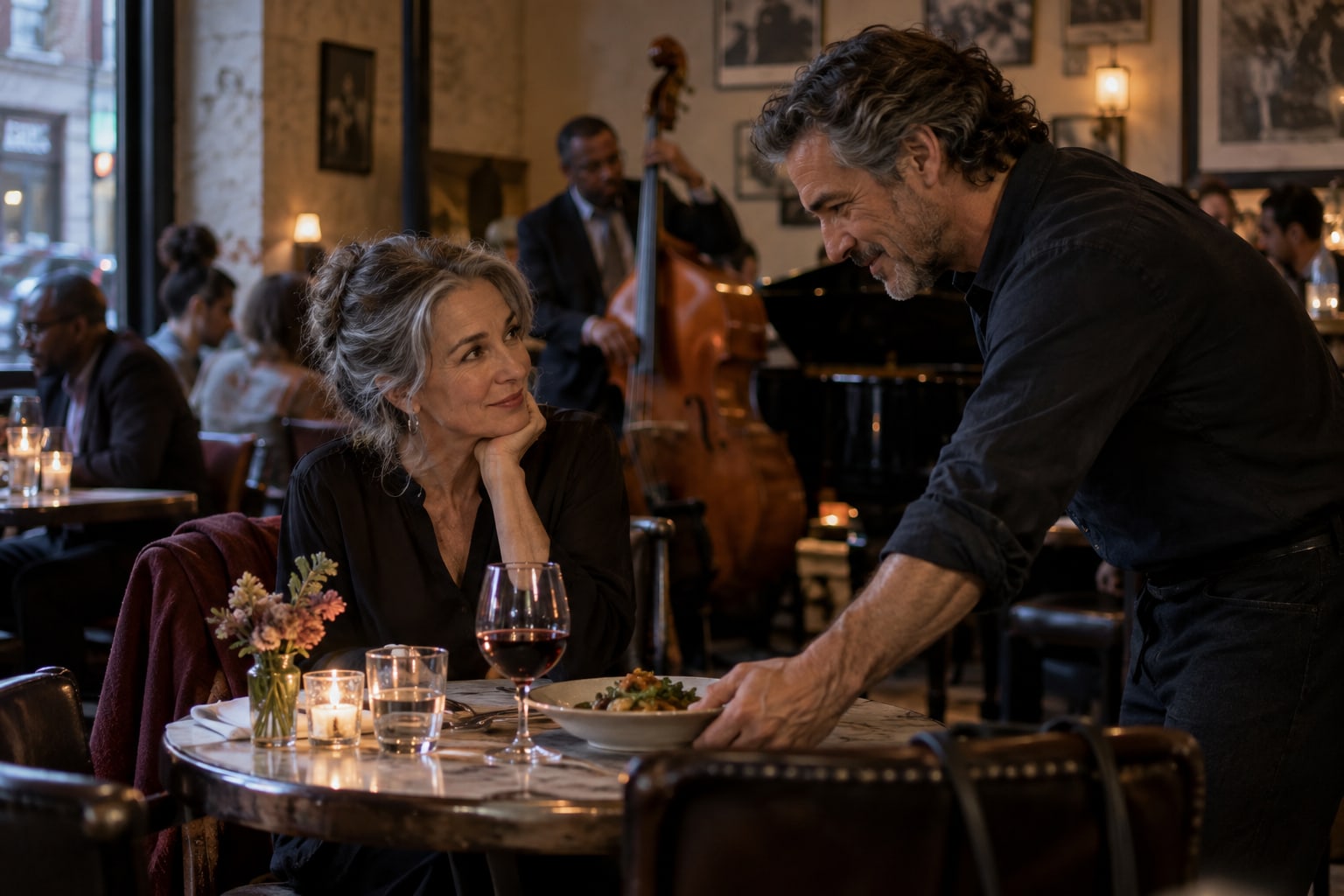
Vivian wrote three replies and sent none of them.
The first was gracious. The second was funny in a way that would have required Gabriel to guess she was annoyed. The third began with the phrase what exactly do you think I can manage, which sounded like the opening of a dispute about a dishwasher warranty.
She put down the phone.
On Monday morning, the message looked no more offensive than it had the night before. We can keep things easy. Short walks. No pressure. Whatever you can manage.
Kind words. Sensible words. Words that somehow left her standing behind a little fence with a sign asking visitors not to startle her.
At work, her editor asked whether she had considered the offer.
"I'm considering it," she said.
"I want you to know how much we value—"
"Martin. Please. I helped edit the statement."
He stopped, then laughed with the relief of a man allowed to put down an awkward object.
"Fair enough. Do you have questions?"
She did. They went through the practical details, the timing, the remaining assignments. Martin answered clearly. The conversation felt better once neither of them pretended that an institution making a financial decision could also provide all the reassurance she needed.
Before leaving his office, she raised another subject.
"I need to recuse myself from any future coverage of Finch & Fork."
"Has something happened?"
"Nothing the paper needs to investigate. I've developed a personal connection there. It would complicate the work."
Martin nodded and made a note. He did not ask for details. Her professional life, at least, still had some useful procedures.
Her personal life offered no such form.
At lunch, Ruth listened while taking the lid off a container of soup.
"Did you tell him you didn't like the message?"
"I'm establishing whether I'm entitled not to like it."
"A complex licensing process."
"He was trying to be considerate."
"Then he may be interested to learn what you consider considerate."
Vivian stole a piece of Ruth's bread. "You were easier to talk to before you started being right about things."
"I've been right since 1998. You were busy."
That afternoon, Vivian sent a different reply.
I enjoyed Sunday too. There is something I'd rather say aloud. Are you free for a call tonight?
Gabriel answered within the hour. Yes. After seven. Nothing more. No demand to know whether he had done something wrong, no escalating string of question marks for her to manage while she worked.
By seven, she had reheated soup, changed out of her work clothes, and reconsidered the call often enough to become irritated with herself.
He answered on the second ring.
"Hello, Vivian."
The sound of her name in his voice reminded her why the message mattered.
"Hello. This is a very small thing."
"All right."
"Although saying that makes it sound as if you aren't allowed to think it's large. Let me try again."
She heard the soft creak of a chair. He was settling in to listen, which should not have been as disarming as it was.
"Your message was kind," she said. "But I don't want you to decide in advance that short walks are what I can manage. I told you Daniel died because you should know something important about me. I wasn't asking you to treat me as fragile."
There was a pause.
"You're right," he said.
She had prepared more sentences. They stood uselessly in line.
"You don't need to agree that quickly."
"I can take longer, but I think I'll arrive in the same place."
She smiled despite herself.
"I meant that I wouldn't rush you," he continued. "But I hear what I actually said."
"I'm not asking to be rushed either."
"Then perhaps I could ask what you want instead of offering a menu of things I think are safe."
Vivian sat on the edge of her sofa. The question was simple. Its answer required more honesty than she had expected to use on a Monday night.
"I want to be asked on a date," she said. "An ordinary, potentially awkward date. I want to decide whether I feel like having one."
"I'd like that too."
"You haven't asked yet."
His laugh came low and warm through the phone. "Would you have dinner with me on Saturday? Somewhere neither of us works."
She looked at the dark window, at the faint reflection of her own smile.
"Yes."
"Good. I was hoping you would."
They talked for another twenty minutes. He admitted he had been nervous about saying the wrong thing and had overcorrected into being unbearably reasonable. She admitted that she sometimes turned a feeling into an editorial problem because editing was easier than having it.
"That sounds tiring," he said.
"The revisions alone are exhausting."
On Wednesday, Gabriel was delivering a repaired violin near her street. He asked whether she wanted company for half an hour. She told him she did, and that he was welcome to make it an hour if the conversation justified it.
He arrived with a small bag of oranges from the market and an explanation that he had bought too many. They ate two at her kitchen table while she told him about a restaurant opening she had attended where the power failed and the owner saved the evening with sandwiches.
"Best meal that month," she said.
"Did you write that?"
"I did. My editor wanted to know where the restaurant review had gone."
"Sounds like you knew."
They stood by the front door when his allotted hour was nearly up. Vivian could see the moment he noticed Daniel's coat. He looked back at her without examining it, and she felt grateful for the absence of a meaningful remark.
Outside, someone rolled a trash bin along the pavement. A dog objected from a window. It was a thoroughly unromantic accompaniment to how close Gabriel was standing.
"I'd like to kiss you," he said.
"I was hoping that might be the next question."
He smiled, and she reached for the front of his jacket, drawing him the last small distance toward her.
The kiss was gentle at first, then certain when she kissed him back. His hand rested against her cheek. She had forgotten the astonishing specificity of being touched by someone new: the careful pause, the discovery, the way a familiar hallway could briefly become an unfamiliar place.
When they parted, she kept hold of his jacket.
"That," she said, "was within my capabilities."
He laughed against her forehead before stepping back.
"I'll remember."
After he left, Vivian remained by the door for a moment. Nothing in the house had moved. The coat was still there. The kitchen needed tidying. Friday's decision waited on the desk.
She touched her cheek, then dropped her hand and laughed at herself.
She was not eighteen. She did not wish to be.
She was fifty-two, with a date on Saturday and a decision to make before it, and for the first time in days she could imagine the decision opening something instead of only closing it.