
Vivian had read a sentence into her empty kitchen seventeen times before noticing that she had begun correcting the kettle's timing.
She turned it off.
The sentence remained imperfect. The kettle, at least, had stopped contributing.
Three weeks had passed since Ruth mentioned the reading. During that time Vivian had written six pages, reduced them to four, restored one paragraph, and developed an unreasonable interest in whether ten minutes could be defined generously.
She had also seen Gabriel often enough to know that he disliked cold plates, forgot where he put his glasses when they were on his head, and hummed while choosing bread. These were facts of no professional value. She found them increasingly important.
The essay was about learning to enter a room without immediately deciding how to describe it. She had begun with her first year at the newspaper, when noticing things felt like a form of citizenship. Then she had written about all the ways attention could become a hiding place.
It was easier to examine the quality of a welcome than admit she wanted one.
She did not include Gabriel's name or the details of their first meeting. They belonged to both of them, and she had not asked to make them public. Daniel appeared only in a brief memory of an argument about whether an uneven omelet required an explanation. Nothing Theo would recognize as privately his had been used.
For years she had removed herself from stories in the name of fairness. Putting herself back required a different kind of care.
At five, Gabriel called to confirm the address.
"You don't have to come," she said, then closed her eyes. "That wasn't the sentence I meant."
"Try another."
"I want you there. I'm also nervous about wanting you there."
"Useful distinction. Would you like me in the back, near a convenient exit?"
"You remember everything inconvenient."
"Only selected things."
She smiled. "Sit wherever you're comfortable. Please don't look as though you expect me to be remarkable."
"I can manage interested."
The bookshop had cleared a space between fiction and gardening. Twelve chairs faced a small reading lamp. Someone had placed water glasses on a table that tilted slightly, and Vivian had to resist the urge to search for a folded napkin.
Ruth stood by the counter wearing earrings Vivian hadn't seen before.
"You look very composed," Vivian told her.
"They clip on. Much easier than inner peace."
Ruth was reading a short piece about the library's lost-property drawer. She had been writing it for months, apparently, between work, family visits, and the inconvenient demands of ordinary life. Vivian realized with embarrassment that she had asked remarkably few questions about it.
"Will you let me read the longer version sometime?"
Ruth looked pleased. "Yes. After tonight, when I can stop hearing every adjective as an accusation."
Gabriel arrived carrying nothing but his coat and the glasses he would soon misplace. He greeted Ruth, then came to Vivian.
"Hello."
"Hello. You look interested."
"I'm following instructions."
He kissed her cheek, an easy gesture that did not announce anything to the room, and chose a chair halfway back. Vivian sat in the front row beside the other readers. She wanted to hear them. She also knew that if she stayed near the door, she might spend the entire evening assessing the distance to it.
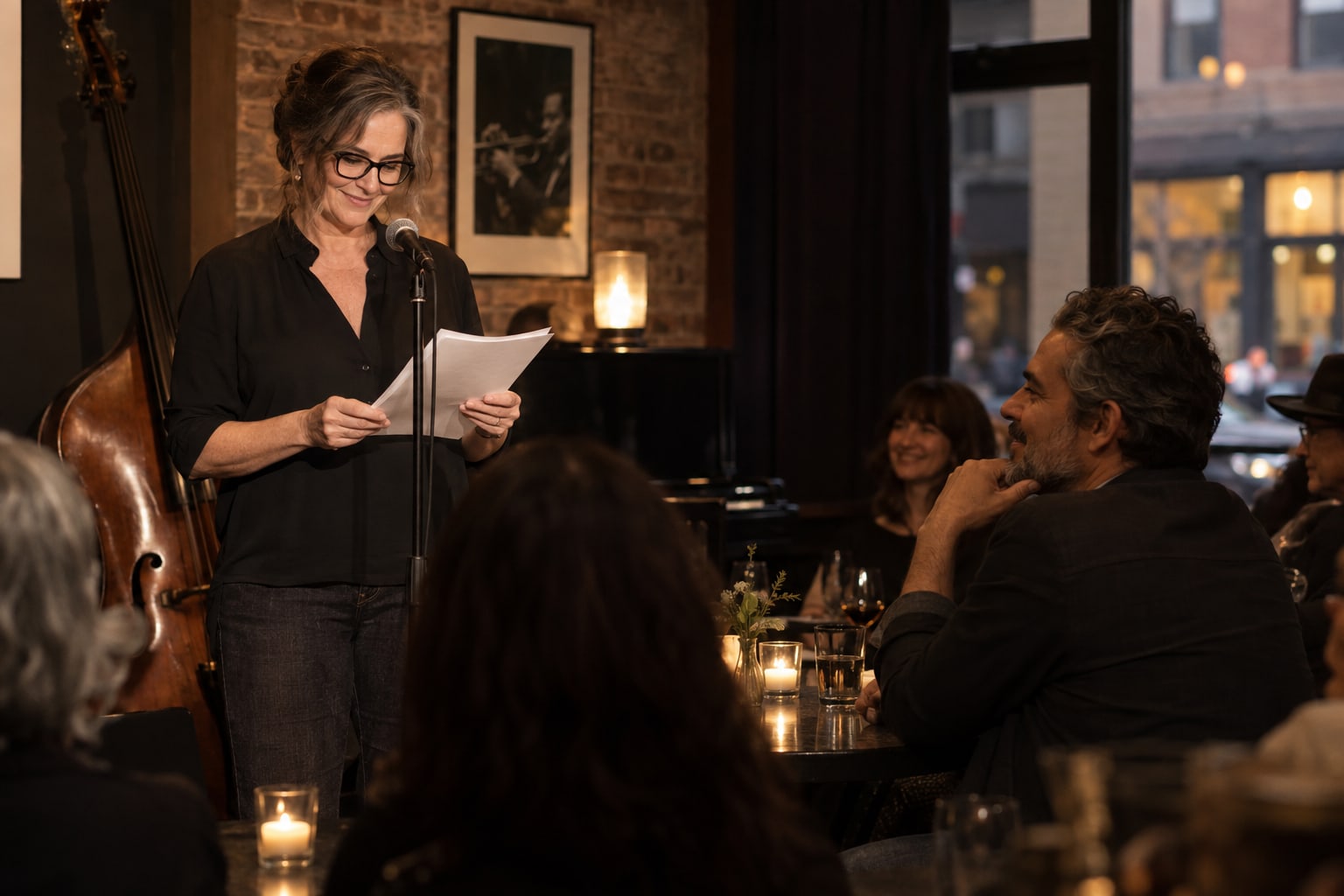
The first reader described caring for an elderly dog with a stronger preference about dinner than anyone else in her household. The second read a poem about a laundromat. Ruth's piece began with a single abandoned glove and became, without insisting on it, a small account of everything people carried through the library.
Vivian listened. Really listened. She forgot to rehearse her own first line for several minutes.
Then her name was called.
She stood, carrying the pages in a folder because loose paper had started to feel like a potential opponent. At the lamp, she looked up. Gabriel met her eyes briefly, then settled back, ready to receive whatever she had brought.
Nobody introduced her as the newspaper's food editor. The host said only that she was Vivian Cross and that she had a new essay to share.
For a moment she missed the rest of the introduction so sharply that she could not begin.
Then someone in the front row smiled at her without recognition, and she read the first sentence.
Her voice sounded slightly strange. It became more familiar by the second paragraph. People laughed where she had hoped they might, and once where she had not expected them to. She left a pause after the omelet story instead of filling it with an explanation.
Daniel had eaten the evidence before telling her it needed no defense. Remembering him aloud brought warmth with the ache. She could feel Gabriel listening, and the room did not divide into old life and new.
The last paragraph was about coming home after leaving the paper and discovering that she still noticed things. The new question was whether she would allow other people to notice her.
She finished. Put down the pages. Heard the applause before she entirely believed it was happening.
Afterward, a woman who had never read her newspaper work asked whether the essay was available anywhere. Vivian said not yet. It felt unexpectedly pleasant to say those words without attaching an apology.
The woman told her she liked the sentence about entering a room. Vivian thanked her, then stopped herself from explaining how long she had worked on it. The sentence had reached someone. She could let that be the whole exchange, without producing evidence of the labor behind it.
Ruth hugged her, then went to speak with someone about her own piece. Gabriel waited until Vivian had finished a conversation with the host.
"Well?" she asked when he came closer.
"I liked the part about the welcome."
"That's nearly all of it."
"Then I was paying attention."
She laughed, relieved enough to be a little unsteady.
"Was it too personal?"
"It sounded like you choosing what to tell us. I liked being trusted with it."
Outside, October air had cooled the pavement. They walked toward a café still open on the next block. Vivian talked about the reading with the unrestrained detail she usually edited out of conversations, and Gabriel let her.
His phone rang while they waited to cross. He glanced at it and smiled before answering.
"Leon. Yes, I got the envelope. No, I haven't disappeared into instrument repair permanently."
The light changed. Gabriel told the caller he would speak to him the following day and put the phone away.
"Old friend?" Vivian asked.
"Leon Brooks. He led the band in the photograph at the workshop. He's putting together a regional tour in the spring. Six weeks, April into May."
"And he asked you?"
"Apparently he remembers the good years."
The smile was still there, though he seemed determined to make it smaller.
Vivian watched him look toward the café as if the news could be folded up with his gloves.
"Gabriel," she said, "that sounds like something you might be pleased about."