
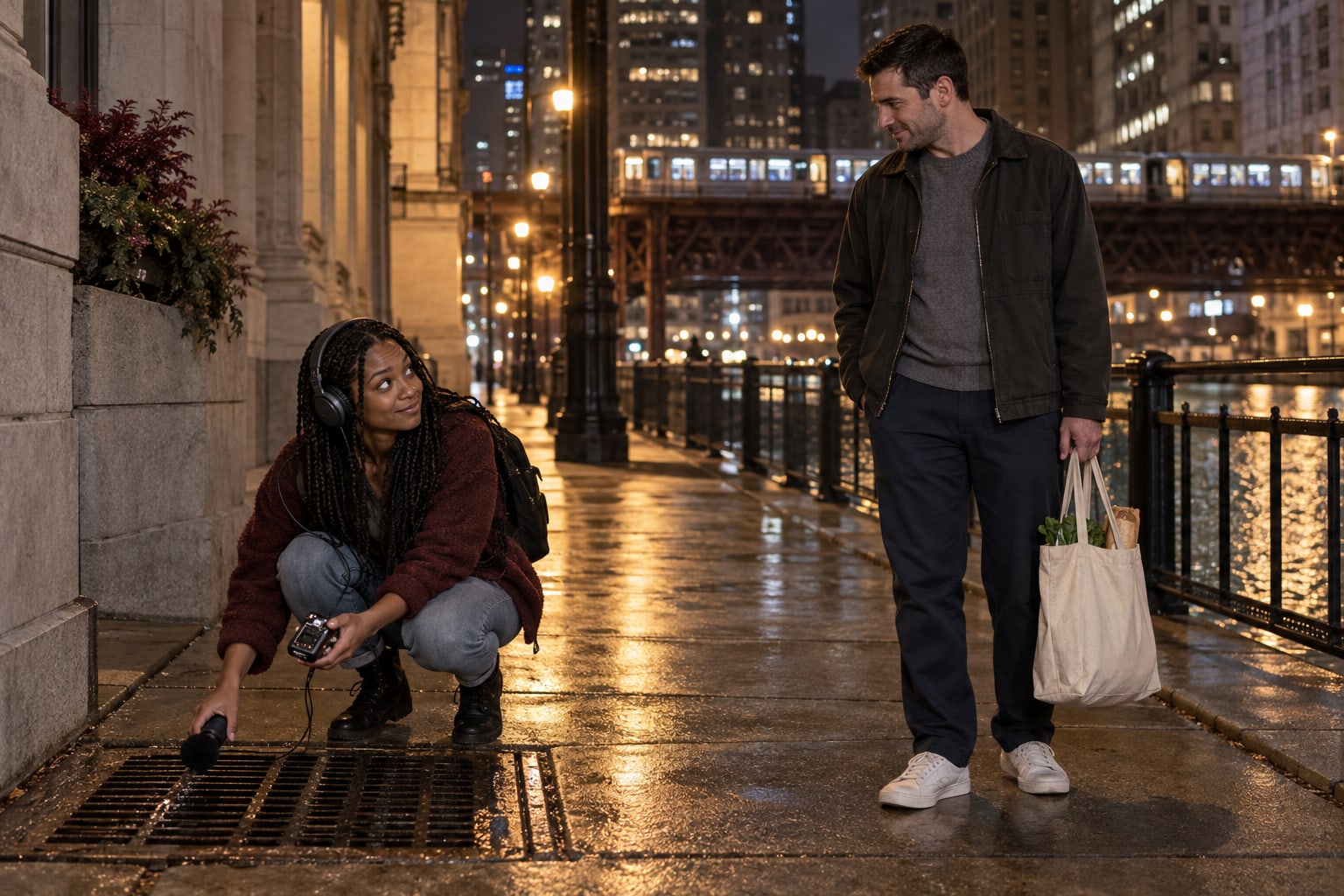
At one seventeen in the morning, Chicago sounded like someone refusing to go home.
A delivery truck complained in reverse. Water ticked beneath a bridge. Farther south, an elevated train rolled through the dark, its windows briefly becoming a necklace between buildings. Maya Brooks stood on the sidewalk with headphones over her braids and a microphone pointed at a storm drain.
The drain had excellent timing. Every time she pressed record, someone started a leaf blower.
There was no leaf blower at one seventeen. There was, however, a man saying, very politely, “Are you listening for something down there, or should I be concerned?”
Maya lowered one headphone. “The city’s neglected percussion section.”
“Good. I was about to introduce myself to a sewer.”
He was a white man with a canvas grocery bag in one hand and the tired, upright posture of someone whose body had forgotten it was permitted to sit. His dark hair was flattened on one side. A pale line marked the bridge of his nose, and his navy work trousers were cuffed above surprisingly immaculate sneakers.
“Medical person?” she asked.
He glanced down. “Is it the fashion?”
“It’s the expression of a man who has heard the phrase ‘just one quick question’ too many times.”
“Nurse. Emergency department. Lucas.”
“Maya. Documentary producer. Professionally intrusive.”
“You announce that up front?”
“Saves time.”
He looked at the microphone rather than her chest, her legs, or the empty street behind her. She noticed that. Then he looked at her face, and she noticed that more.
“Am I in your recording?”
“Not anymore.” She stopped the recorder and held up its dark screen. “I don’t use conversations without permission.”
“Then I withdraw my remarks about the sewer. They were unkind.”
She laughed hard enough to shift the headphones. The week had contained a rejected grant, an email beginning Unfortunately twice in one paragraph, and a meeting in which a man had described her own proposal back to her as a suggestion. Laughing at a stranger felt extravagant.
Lucas nodded toward the closed storefront behind them. “There’s a refrigeration unit around the corner that sounds like a ship leaving port. If you’re collecting neglected instruments.”
“I know that unit. It’s my bass line.”
“You’re ahead of me.”
“Professionally, yes.”
He grinned. It changed his face from competent to trouble.
Maya had spent six weeks collecting the sounds of people working while other people slept. The project was called After Hours, though her editor, Evan Bell, wanted something “more immediately clickable.” She had suggested Wake Up, Evan. He had not put that in the meeting notes.
She wanted listeners to hear the careful work beneath the bright skyline: a baker folding cardboard boxes, a train cleaner wringing out a mop, a woman unlocking a twenty-four-hour laundromat because the latch stuck after midnight. No tragedy assigned to a stranger simply because her shift ended late. No sweeping music over someone explaining how they paid rent.
So far she had seventeen hours of audio, three enthusiastic participants, and no money beyond the tiny development allowance Lakefront Audio had advanced her. She also had a sound in her head she could not find: the moment the city seemed to take a breath.
“Try the river path before the next train,” Lucas said when she explained that last part. “The trucks clear for a minute.”
“Do you always give directions to women holding equipment?”
“Only when they’re pointing it at municipal plumbing.”
She checked the path. Lighted, open, another couple walking a dog. “I’m going that way.”
“So am I. For about a block.”
They walked with a comfortable distance between them. His grocery bag clinked.
“Excellent shift?” she asked.
“Long shift.”
“Is that the professional answer?”
“It’s the answer that doesn’t turn people’s worst nights into somebody else’s entertainment.”
Maya glanced at him. “Good answer.”
“The bag contains cereal, if you need a shocking revelation.”
“At this hour?”
“Cereal doesn’t recognize authority.”
At the railing, she set her bag down and adjusted the microphone. Lucas moved a few paces away without being asked. The river gathered the buildings into broken strips of gold. Somewhere underneath the traffic was the soft slap of water against concrete.
She lifted a finger. Wait.
He waited.
For eleven seconds, the city loosened its grip. No voices, no brakes, no airplane. Only water, a faint electrical hum, and the wind pressing gently against the microphone’s cover.
When a train arrived, Maya lowered her hand.
“That,” she said.
Lucas looked pleased, as if he had made the eleven seconds himself.
She played the clip through one side of her headphones. He bent closer to listen without touching her. At that distance she caught clean soap beneath the cold outdoor smell of his jacket. His concentration was absolute. Most people listened to a recording while waiting to offer an opinion. Lucas listened until it ended.
“There’s a little tap in it,” he said.
“Your bag.”
He looked appalled. “I have disgraced the cereal.”
“It’s useful. Keeps it human.”
Her phone vibrated against the railing. RENÉE: Alive? Famous? Arrested for interviewing a fire hydrant?
Maya sent a quick photograph of the river, carefully keeping Lucas outside the frame. Alive. Found eleven good seconds.
Renée replied with a heart and, immediately afterward, Tessa says wear the sensible boots.
Maya was already wearing them. Her friends’ confidence in her judgment varied inversely with their distance from her.
“Check-in?” Lucas asked.
“My friends maintain a highly annoying civilization.”
“Sounds useful.”
His own phone lit. He read the message and typed with one thumb, his smile softening into something private. Maya looked away. She had no claim on his night, not even enough to wonder whether there was a woman waiting somewhere for that grocery bag.
“My sister,” he said, putting the phone away. “She thinks I forgot our father’s birthday.”
“Did you?”
“I bought his present in June.”
“That sounds suspiciously like something a man who forgot would say.”
“It’s a very good present.”
“Which is?”
“I can’t tell you. You might know him.”
She laughed again. The river had gone back to being loud.
At the stairs, they stopped. A taxi moved across the bridge above them, yellow reflected for a second in the metal railing. Lucas shifted the bag into his other hand.
“I’d like to see you when you’re not working,” he said. Directly, with no rehearsed apology. “Would you like that?”
Maya’s last relationship had ended with a man telling her that needing a recording session on his preferred date night proved she did not understand partnership. The man before that had loved her ambition until it occupied actual hours. She had developed a respectable talent for declining things before they could become disappointing.
Lucas waited without filling the silence for her.
“Possibly,” she said. “My schedule is bad.”
“Mine’s worse. We could hold a competition.”
“And I ask too many questions.”
“I might answer some.”
She took out her phone. “One coffee. No promises beyond that.”
He gave her his number, then watched her type his name.
“You can put Lucas Cereal if it helps.”
“I was going with Sewer Consultant.”
“More dignified.”
They parted at the top of the stairs. Halfway to her car, Maya’s phone chimed.
For the record, the present is a turntable. Don’t tell every Frank in Chicago.
She was smiling when another message arrived, this one from Evan.
Current wants to hear your night project. Big opportunity. Tomorrow, nine. Bring something intimate.
Maya looked back toward the river. Lucas had disappeared into the lit city, taking his cereal and the improbable ease of the last twenty minutes with him.
For the first time all week, the word intimate did not sound like a production note.