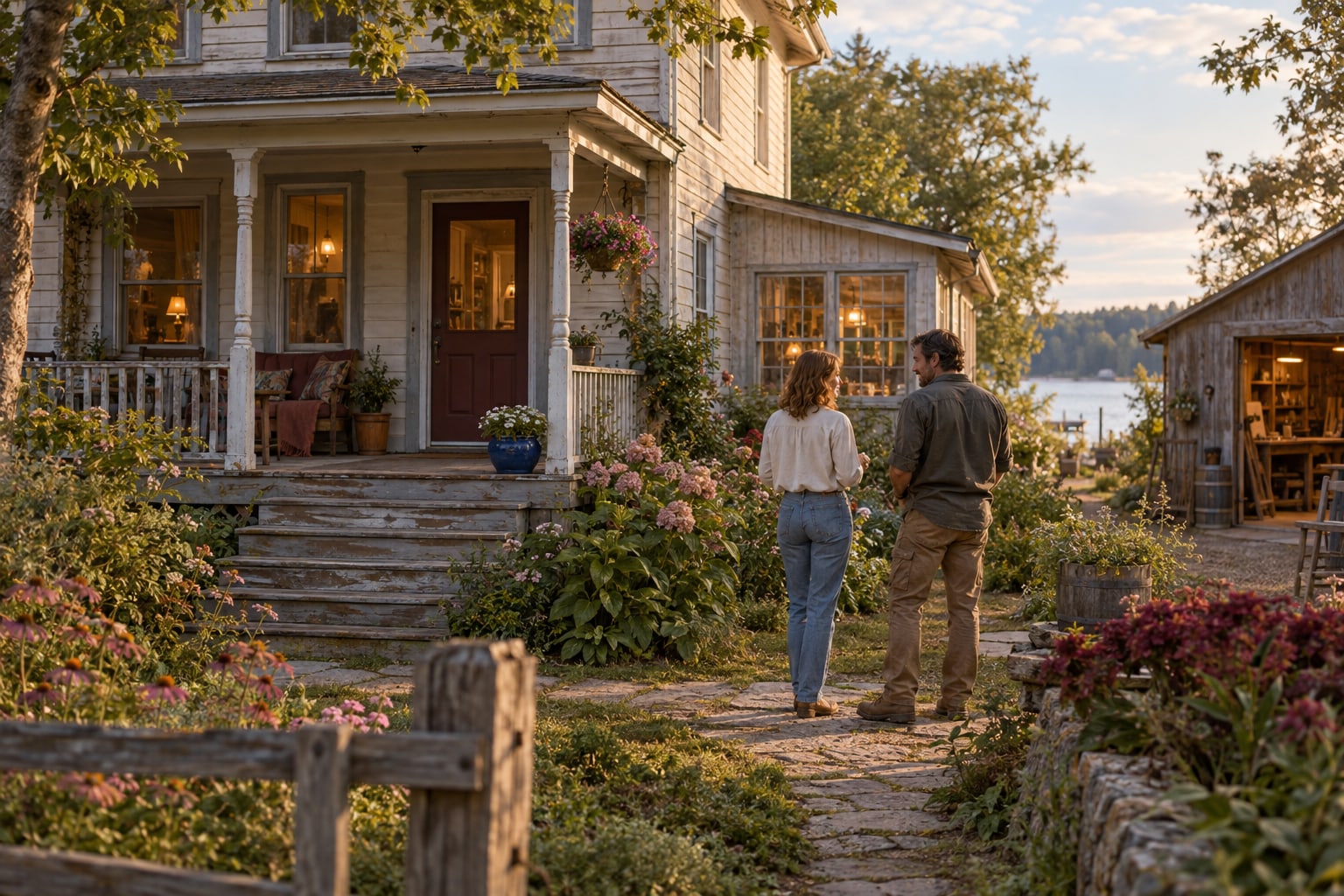

They reached a bench above the beach before Ben found the next sentence.
Audrey sat at one end, leaving room for him. He remained standing for a moment, looking toward the inn's blue roof in the distance. She knew that posture. He used it when deciding whether a repair would take longer than he had promised.
This time she waited without offering an estimate.
"At the shop, I know what I'm for," he said. "Someone brings in a problem. I understand it. I do something useful. Usually they leave happier than they arrived."
"Usually?"
He gave her a brief smile. "Some people are deeply attached to having the wrong saddle."
She smiled back, and he sat beside her.
"At home, I started feeling like I only knew how to be useful. Fix something. Pay for something. Drive somewhere. I don't think I realized how often I was waiting for you to tell me what to do because then I'd know I'd done it right."
Audrey folded her hands in her lap. There were several answers available to her, including an angry one about how much work that had created. She had already said that part. She wanted to hear what came after it.
"You're good at your work," he continued. "You walk into a room and understand things other people haven't even noticed. Sometimes you'd tell me about a meeting, and I'd get lost. Instead of saying I didn't understand, I'd start thinking about something I could answer."
She turned toward him. "You could have asked."
"I know. I didn't want to sound stupid."
"Ben."
"I know," he said again, more gently. "You didn't make me feel stupid. That part belonged to me."
The distinction mattered. She felt some of the defensive response leave her shoulders.
He looked at his hands.
"Then Max got older. He needed less from me. Which is good. It's what we wanted. But I kept walking into the house and looking for something practical to do because I didn't know how to say I wanted company."
"You wanted company from me?"
He looked up, surprised. "Of course from you."
"You often looked like you wanted to be left alone."
"I was tired. And I thought you were busy. Or annoyed with me. Sometimes you were annoyed with me, for good reasons."
She looked out at the water. A small boat moved slowly beyond the curve of the bay. She thought of all the evenings they had spent a few feet apart, each deciding that the other had already made a choice.
"I wanted you to ask me to sit down," he said. "Which sounds ridiculous now that I'm saying it. I live there. I could have sat down and asked about your day."
"It doesn't sound ridiculous to want to be wanted."
His expression changed. He swallowed once and nodded.
Audrey let the silence stand. She did not tell him that everything was all right. Everything was not all right. But something important had become visible, and she was relieved not to have to guess at its shape anymore.
"I can't be the person who hands you a task and then reassures you that you matter," she said. "Not all the time. I need you to come toward me too."
"I understand."
"And I can tell you when I want you instead of hoping you'll read my mind and being hurt when you don't."
He turned his palm up on the bench between them, as he had in the car. She put her hand in his.
They sat until the wind became cold enough to make the next decision simple. On the walk back, Ben asked what she wanted for dinner. Audrey considered the question without translating it into a whole plan.
"Something easy. I don't feel like another restaurant."
"We could use the little kitchen. June said that was all right."
"I'd like that."
At the shop near the inn, they bought soup, bread, apples, and a small wedge of cheese. Ben chose the soup. Audrey chose the cheese. Neither consulted a list.
June showed them which pans belonged to the guest kitchen and which were inexplicably beloved by a former guest who had mailed one back after accidentally taking it home.
"People form attachments," she said. "Usually I prefer they form them to the view."
She left them to it.
Ben heated the soup while Audrey sliced the bread. The room had a small table under a window looking toward the garden, where a wooden chair leaned permanently to one side. Someone had placed a pot of herbs beside the sink.
"Do you remember the first meal you cooked for me?" she asked.
"I'd prefer you remember a later one."
"Pasta. Enough for a youth orchestra."
"I was concerned you might be hungry."
"You put the entire packet in because you didn't know how much it expanded."
He laughed. "I was twenty-three and confident. A dangerous combination."
They had known each other for a year before the wedding. She remembered him arriving at her apartment with a saucepan because hers was too small, making a complete mess, and washing up while she sat on the counter telling him about a professor who had underestimated her.
He had listened then. Not perfectly. Not with wisdom beyond his years. He had simply wanted to know what she thought.
"You asked me to tell you the rest of a story once," she said. "After I stopped because I thought you weren't interested. I remember being surprised."
He looked at her over the pan. "I was interested."
"I know."
He set the spoon down.
"I am interested, Audrey. I've been behaving as if having known you a long time means I don't have to keep finding out."
She leaned back against the counter. The sentence reached her more directly than any promise about the future.
"There's quite a bit I haven't finished saying."
His smile was quiet. "I've got the evening."
They carried dinner to the little table. Outside, the light was leaving the garden. Ben found a lamp rather than switching on the harsh ceiling light, then moved his chair so the narrow table leg wouldn't press against her knee.
She noticed. She was tired of pretending that noticing made her demanding.
"Thank you," she said.
"For the lamp?"
"And the chair."
He nodded, accepting the thanks without adding it to an invisible score.
They began to eat. Audrey told him about a colleague who collected terrible meeting phrases and had recently added actionable umbrella to the list. Ben laughed so hard he had to set down his spoon.
Watching him, she felt something she had missed and not yet named aloud.
Not relief. Not nostalgia.
She wanted the evening to go on.