
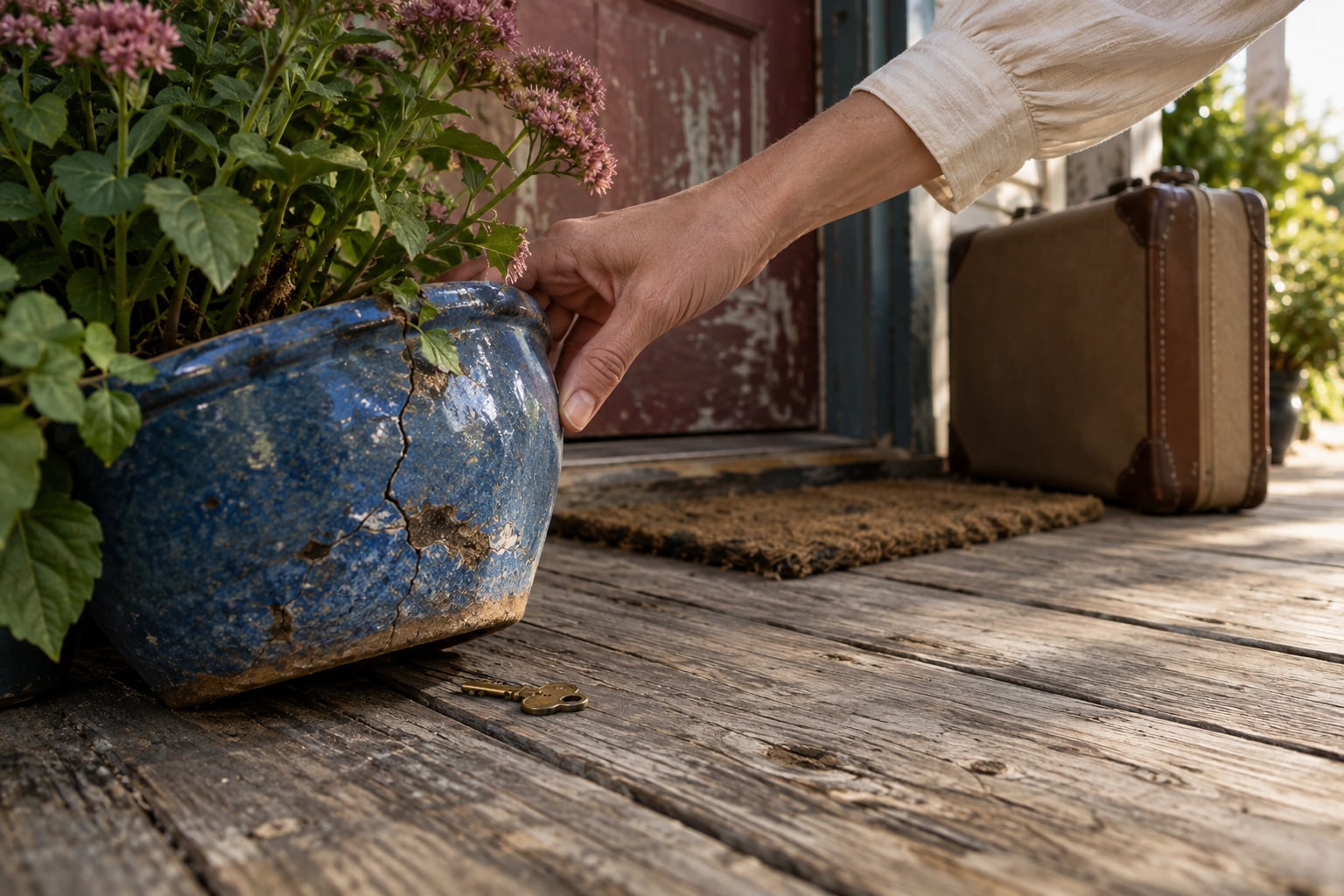
The key was exactly where Aunt June had said it would be, beneath the blue flowerpot with the crack shaped like a river. Nora Bennett had spent forty minutes searching her bag before remembering that the woman who had taught her to draw shadows had never trusted a key ring.
She stood on the porch with a suitcase against her shin. Across the street, late August light settled on the roofs of Bellweather, Michigan. The lake was out of sight, but she could smell it, cool and mineral beneath the heat rising from the road.
The house had acquired a lean since her last visit. Or perhaps Nora, at forty-one, had become better at recognizing the effort required to stay upright.
She pushed the key into the lock. It turned. The door did not.
“Lift the handle as you push.”
A man stood in the neighboring driveway, holding a length of white trim. He wore faded work trousers, clear safety glasses pushed into dark hair, and an expression that suggested he had already decided not to come over unless invited.
Nora lifted, pushed, and stumbled into the door when it surrendered.
“That was dignified,” she said.
“House likes an introduction.”
She looked back. “Nora Bennett.”
“Eli Mercer. I knew June.”
The past tense landed between them. For eight weeks people had said it carefully, as if putting padding around a broken cup. He simply waited.
“I’m finding that she knew everybody,” Nora said.
“Most people. Had opinions about the rest.”
That made her laugh, her first unplanned laugh since leaving Chicago. Eli smiled, lifted the trim in farewell, and returned to his garage. He did not offer to carry her suitcase. Somehow the absence of the offer felt generous.
Inside, the duplex smelled of lemon oil, old books, and the dusty sweetness of closed rooms. June had lived in the left half. The right had been empty since her last tenant moved in the spring. Beyond the kitchen stretched the low annex where June had once printed cards and held her irregular, fierce little art classes.
Nora set her suitcase down beneath a watercolor of Lake Bellweather in winter. On her final hospital visit, June had squeezed her hand and said, Make room for yourself, sweetheart. Then, after a difficult breath, For other people, too.
Nora had interpreted that as a suggestion about grief. The envelope propped against the kettle suggested June had meant square footage.
For Nora, when you have a cup of tea, the front read.
She obeyed because the kettle worked, because rituals were easier than decisions, and because there was still a tin of the smoky tea she disliked and June adored. While it boiled, Nora opened the kitchen window. Somewhere nearby a radio played quietly. A saw started and stopped.
The letter was only two pages. June apologized for the yellow bathroom, recommended a plumber, and insisted that Nora should not preserve every object simply because a dead person had owned it. Then the handwriting grew smaller.
The shop was always meant to be a place where people could make things without having to apologize for the mess. There is a promise attached to it. Ask about Celia before you decide what it ought to become. I should have explained properly while I could. Being old is no excuse for being a coward, although I tried it for a while.
Nora read that paragraph twice.
Celia. A name from summer afternoons, perhaps. A woman who had smelled of oranges and ink. Nora remembered broad silver rings and someone saying that red could be a quiet color if you gave it enough space.
The phone on the table vibrated. Her Chicago art director had sent three cheerful messages about a packaging project whose budget had mysteriously remained cheerful while the deadline moved closer. Beneath them sat an email from her ex-husband about the final reimbursement for their old condo.
She turned the phone facedown. This house was supposed to be the uncomplicated part.
By four, Nora had established that the refrigerator worked, the upstairs left toilet did not, and every cabinet contained a different category of string. She had also measured the empty right-hand living room. Her drawing table would fit beneath the windows. Two long worktables could stand down the center. She could live on one side, work and teach on the other, and restore the annex when she had the money.
It was possible. Not easy, not the picturesque reinvention her friends had imagined, but possible on the inheritance, her savings, and a steady amount of commercial work.
She wrote those three sources in a notebook. Underneath, she wrote, No miracles in the budget.
At half past five she attempted to open the annex door.
The knob moved. The door stayed shut. Nora applied the technique Eli had suggested, then her shoulder, then a sentence June would have admired. A small drift of plaster fell onto her hair.
“I take it the introduction didn’t work.”
Eli stood beyond the open kitchen window, hands empty this time.
“I’m trying to see the shop.”
“That door swells. There’s an outside entrance.”
“I saw the padlock.”
“June kept the key in a sugar bowl.”
“Of course she did.”
He glanced at the plaster on her shoulder. “Would you like company while you look? There’s a patch by the east wall I wouldn’t trust.”
She considered the question. Her marriage had contained many offers that became decisions on her behalf. This one remained an offer.
“Yes. Thank you.”
They found the key in the third sugar bowl and walked around the house through waist-high asters. The annex had its own narrow porch and a green door with faded gold lettering. JUNIPER PRINT ROOM, Nora read, surprised that she remembered the words before she could make them out.
Eli unlocked the padlock and stepped aside. “You first. Stay left.”
The room smelled of dry wood and metal. A printing press waited under a sheet. Light entered through windows filmed with years of weather, touching shelves of type, jars of hardened brushes, and a stack of small chairs. Nora crossed to a workbench and found a crescent of blue paint where her aunt had wiped a thumb.
Grief arrived without ceremony. One minute she was assessing a room. The next she could not draw a full breath.
Eli made no move toward her. He looked at the window, giving her the privacy of not being watched.
“I thought,” she said, then stopped.
“Take your time.”
She pressed her palm against the bench. “I thought coming here would feel like getting something back.”
“Sometimes it does. Sometimes it just makes what’s missing more specific.”
She looked at him then. He did not explain how he knew. She was grateful for that, too.
After a while they inspected the suspect floor. Eli crouched, tested a board without putting his weight on it, and suggested an independent structural assessment before she planned classes. When she asked whether he did restoration work, he nodded toward his own garage.
“I can give you a written estimate. You should get another.”
“June would have liked that answer.”
“June thought I undercharged.”
At the far end of the room, Nora discovered a painted panel partly hidden by shelving. She shifted a cardboard box. Two women stood side by side in the mural, one carrying a stack of paper, the other holding open a door. Their faces were stylized, but June’s red scarf was unmistakable.
Below them, in small careful letters, someone had written: A room belongs to the people who make room.
“Who painted this?” Nora asked.
Eli came closer, leaving a comfortable space between their shoulders. “Celia Shaw, I think.”
“My aunt left me a letter about her.”
His attention sharpened. “Then you’ll want to talk to Tess at the library.”
Before she could ask why, her phone rang. The caller was the attorney handling June’s estate.
Nora answered beside the painted open door.
“I’m glad you arrived safely,” the attorney said. “There’s something about the print shop parcel we need to discuss before you begin any work.”