
The attorney gave Nora the useful news first. The duplex was hers. She could live in it, repair it, paint every surface purple if she wanted. The trouble concerned the smaller parcel beneath the attached print shop and its garden.
“Your aunt owned half of that parcel,” Marisol Vega explained over the telephone. “Celia Shaw owned the other half. Celia’s interest went through her estate, but the record we received from June’s file was incomplete. We’re confirming the current ownership.”
Nora sat on the kitchen floor because it was cooler than the chair. “June never mentioned a partner.”
“People are often less orderly than their filing systems suggest.”
“You should see her filing system.”
Marisol laughed gently. She advised Nora to keep the shop closed, preserve anything relevant to its history, and proceed with ordinary work on the duplex. The complication required information, not panic. Nora wrote that down because she was inclined to manufacture the latter when deprived of the former.
By ten she was at the Bellweather library, carrying June’s letter and wearing jeans with a dusty white handprint on the thigh.
The woman behind the circulation desk examined her over red glasses. “You have June’s eyebrows.”
“I was hoping for her courage.”
“Eyebrows are a start. Tess Alvarez.”
Tess emerged from behind the desk and gave Nora a hug that lasted precisely long enough. She was fifty, compact and energetic, with a silver streak at her temple and six pencils trapped in her hair.
“I knew you in summer,” she said. “You used to sit on the back steps drawing shoes.”
“Faces were hard.”
“They still are. Come upstairs.”
In the local history room, Tess found a newspaper clipping from 1989. Two women stood outside the print shop, younger versions of the mural’s figures. June held oversized scissors. Celia, a Black woman in a patterned shirt, looked directly into the camera with a wry smile.
“Celia made beautiful block prints,” Tess said. “Landscapes, mostly. She also kept the accounts. June was good at enthusiasm.”
Nora read the caption. June Bennett opens neighborhood arts space. Celia’s name did not appear.
“That’s not much of an account of a partnership.”
“No. We have other records, but that clipping gets used because it has a clear photograph.”
Tess let the silence stand. Nora appreciated that she did not rush to defend June or turn one omission into a complete verdict on a life.
“Why did Celia leave?” Nora asked.
“She moved to Milwaukee to help her daughter after surgery. Then she found work there, and life continued. She visited, but the classes here became June’s thing. Celia died five years ago. Her daughter, Denise, died this spring.”
“There’s a granddaughter?”
“Mae. We’ve exchanged emails about donating some prints. I can ask whether she’d welcome an introduction.”
Nora nodded. “Please tell her I’m trying to understand, not persuade her.”
Before she left, Tess copied the photograph with a new note attached: June Bennett and Celia Shaw, cofounders. It was a small correction. Nora found she could breathe more easily looking at it.
Lunch became coffee when she entered the Lantern Café and discovered that its owner had known she was coming since breakfast.
“Bellweather has two internet providers and one reliable information network,” Priya Desai said. “The network is Tess.”
Priya was thirty-nine, with flour on the sleeve of a black T-shirt and the brisk warmth of someone who had run a café through three winters. She gave Nora a bowl of tomato soup and charged her for it before Nora could protest being fed out of sympathy.
“June bought the first cake I made professionally,” Priya said. “It leaned to the left. She called it expressive.”
“Did she know a lot about cake?”
“She knew a lot about people who were frightened.”
They spoke about the empty apartment, Nora’s illustration work, and the unnerving expense of reliable gutters. Priya suggested starting with one class a week in the duplex while the annex waited.
“You can build something slowly,” she said. “Everybody selling a transformation forgets to mention rent.”
Nora left with a loaf of bread she had willingly bought and the pleasant surprise of having made a friend without auditioning for the role.
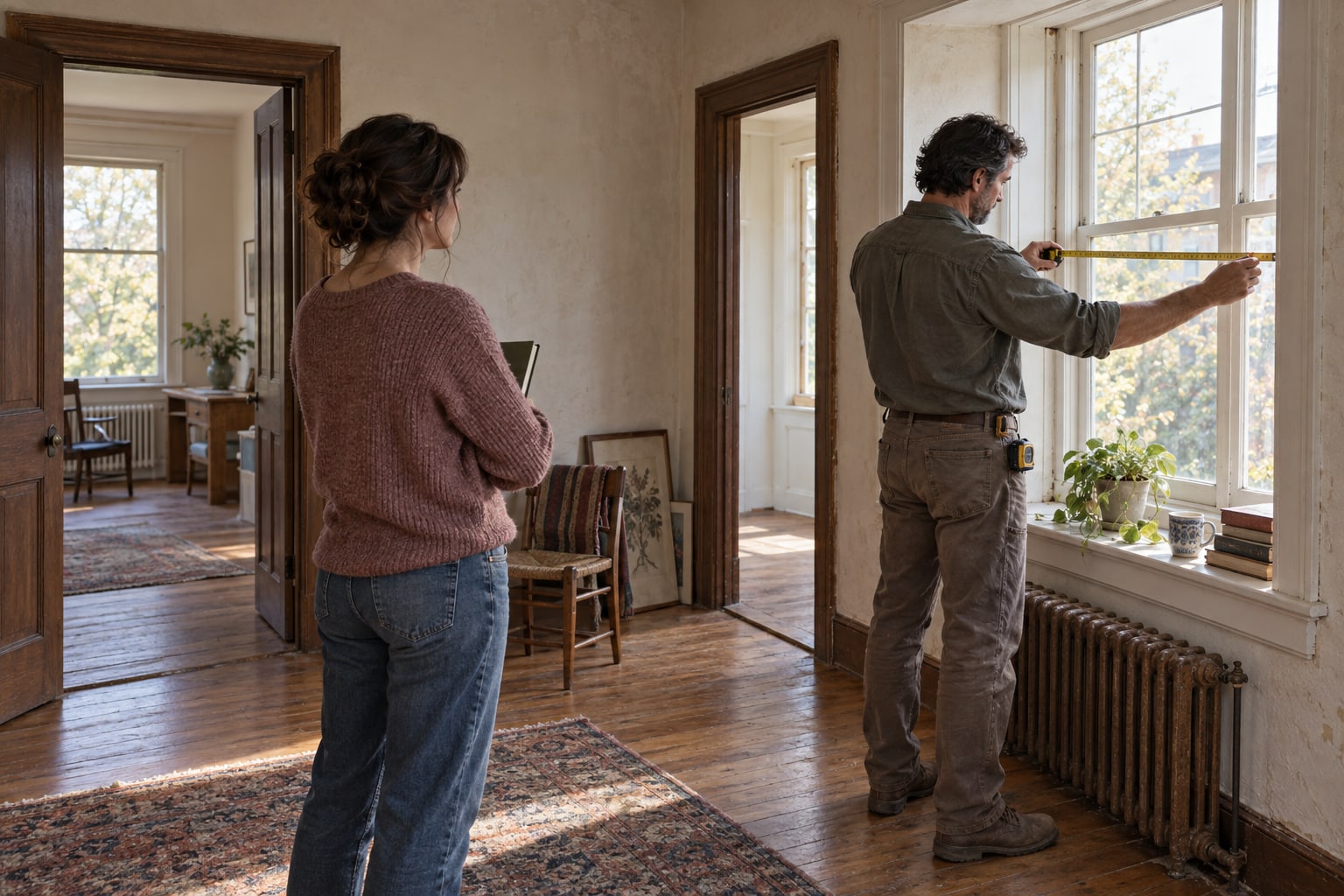
Eli arrived for the agreed inspection at two. He brought a tape measure, a notebook, and a pair of clean shoe covers, which seemed optimistic given the state of the floors.
“I’m trying to establish professional credibility,” he said when she looked at them.
“You already knew about the sugar bowls.”
“That was my introductory offer.”
They began in the right-hand apartment. Nora explained her plan: an accessible workroom downstairs, a small illustration office upstairs, and her own home next door. He listened without improving it for her. When he did ask questions, they were about the way she would use the rooms.
“Do people need to wash brushes without crossing your work area?”
“Yes. And I want a corner where someone can sit without having to explain why they aren’t making anything.”
Eli made a note. “A chair by that window would get afternoon light.”
“You’ve thought about this.”
“My father used to come to June’s classes. Mostly he sat.”
“Does he still live here?”
“At Harbor House. His hands don’t do what he asks of them anymore.”
There was affection in his voice, and something carefully folded behind it. Nora did not tug at the fold.
Upstairs, Eli found a window painted shut and a cracked sash cord. Downstairs, they discovered sound joists, inconvenient outlets, and a back door that needed a proper landing. He distinguished necessities from improvements, then suggested a qualified electrician and an accessibility consultant.
“You say ‘later’ a lot,” Nora observed.
“Usually means a project has a chance of surviving.”
At the old dividing door between the apartments, Nora paused. It had been sealed for years, but June had left its outline visible under the wallpaper.
“I’d like this to open again.”
“For work?”
She thought about carrying tea between the two halves. About shutting the door at the end of a day. About having a choice.
“For me.”
He looked at her a moment longer than the question required. “Then we’ll make sure it closes properly, too.”
The sentence warmed her in a place she had not expected to notice a carpenter.
When they finished, he spread the measurements across the kitchen table. He would send an estimate, and she would collect another. Work could begin in September if she chose him. Neither mentioned the annex except to agree that the soft floor remained off limits.
As he packed up, Nora’s phone lit with Tess’s message. Mae Shaw was willing to talk. There was a photograph attached, sent with permission: Celia in the garden beside the print shop, one hand on a young girl’s shoulder.
Under the photograph was Mae’s own message.
My grandmother called it the room she never got back. I’m coming to Bellweather Friday. I’d like to see what’s still there.
Nora looked through the kitchen window at the annex’s green door. For the first time since arriving, she understood that inheriting a place did not mean inheriting the only story about it.