
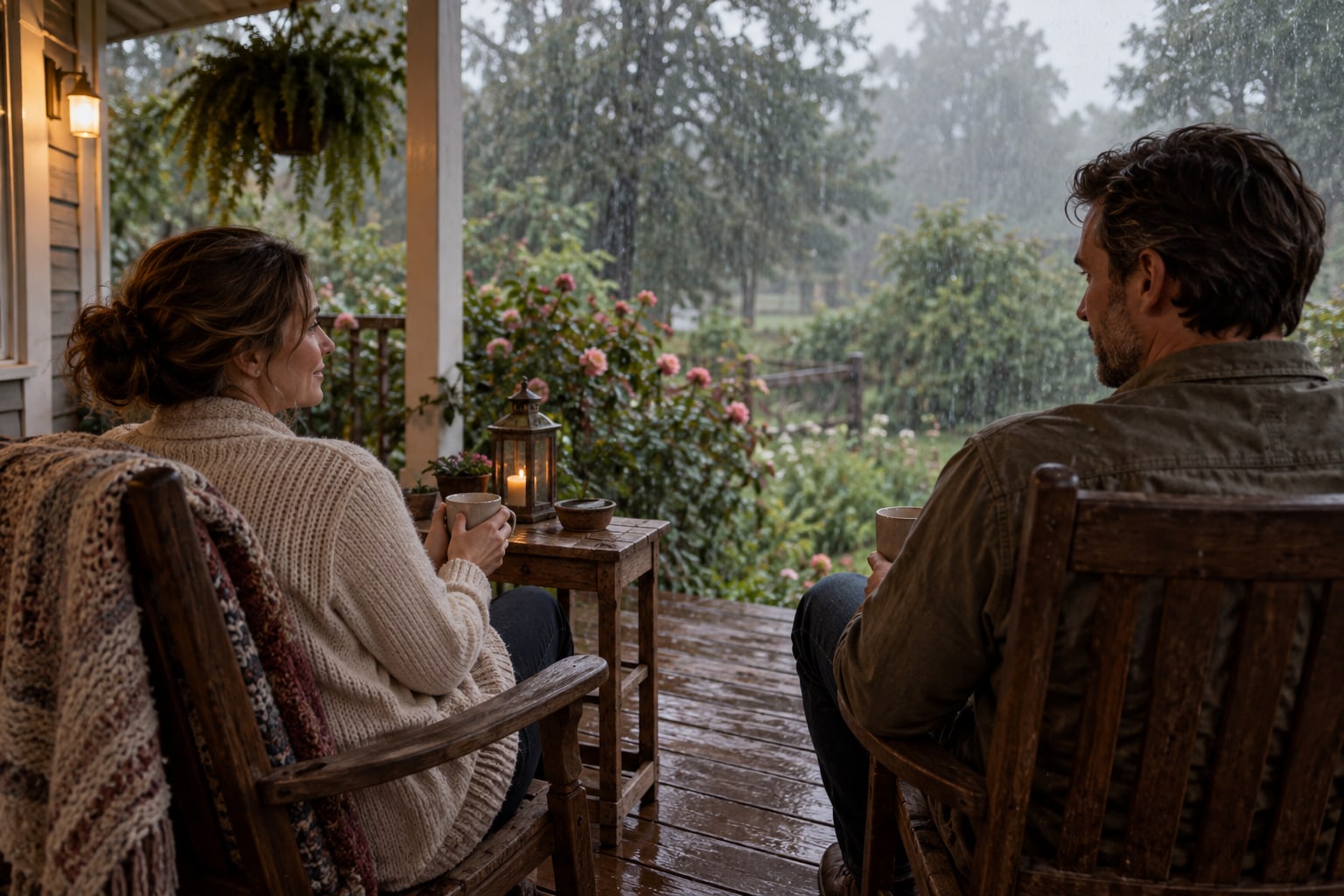
The rain began just as Nora carried the last cabinet door onto the porch. It came hard enough to flatten the asters and send her running backward beneath the roof, where Eli was examining a stubborn hinge.
“That seems personal,” she said.
He looked at the sky. “September likes to introduce itself.”
They had been working for three days. Eli handled the repairs listed in his contract; Nora removed hardware, washed walls, and learned that a room could contain considerably more dust than its dimensions suggested. She kept her illustration mornings protected. He arrived after nine and left the upstairs office alone unless invited.
The arrangement was sensible. Her growing awareness of his movements was less so.
He placed the hinge in a labeled jar. “We’re done outside for a while.”
Nora reached for the cabinet door nearest the steps. A windblown sheet of rain struck the porch, and Eli caught the other end before it slipped. Together they carried it inside, laughing when her wet shoe squeaked across the kitchen floor.
The lights blinked once. Then the refrigerator sighed into silence.
“No,” Nora told the ceiling.
“Probably the whole block.” Eli checked his phone. “Outage reported. Utility says they’re assessing it.”
“I have a client call in forty minutes.”
“Battery?”
“Enough. Internet?”
He pointed to her phone. She stared at it, then at him.
“I work in technology every day. Apparently losing a lightbulb takes me back to the nineteenth century.”
He left her to set up a hotspot while he secured the tools. The call began on time. Nora presented the approved pear designs from a laptop balanced on two cookbooks and refused a request for three free seasonal variants with a calm she did not entirely feel.
When it ended, Eli was on the porch with two mugs of coffee from a thermos.
“One is clean,” he said. “The other is also clean, but I thought you might appreciate certainty.”
She took the blue mug. “How long were you listening?”
“I heard ‘that would require a separate scope.’ Then I felt professionally inspired.”
They sat on the porch steps, safely back from the rain. Across the street, water ran silver along the curb. The world had become smaller, bounded by the roof, the garden, and the steady noise of weather.
Nora wrapped her hands around the mug. “My marriage would have lasted longer if I’d learned to say that sentence sooner.”
“Separate scope?”
“Clear expectations. Actual agreement. A price for changing everything halfway through.”
Eli leaned his shoulder against a porch post. “Might have made it shorter.”
She turned to him. He looked almost apologetic.
“That’s true,” she said. “I hadn’t considered the efficient version.”
For a while they watched rain collect on the peony leaves. Nora told him about the condo in Chicago, where she had stored her drawing board behind the guest-room door because her husband preferred the room to look finished. She had agreed. That was the part she was learning to say without turning it into an accusation against herself.
“He wasn’t a monster,” she said. “I don’t need him to be. We made a life that suited him, and I kept waiting for my turn.”
“What would your turn have looked like?”
The question caught her. People usually asked what had gone wrong. Eli asked what she had wanted.
“A room I could leave unfinished. Friends over without worrying whether dinner was impressive. Work I cared about that didn’t need to earn its place every hour.”
“Sounds like you’re building it.”
She glanced behind them at the crooked cabinet doors. “Very slowly.”
“Usually the durable way.”
A gust pushed rain under the roof. They moved closer to the wall, and his knee came to rest beside hers. He did not slide away. Neither did she.
“What about you?” Nora asked. “What did you keep waiting for?”
Eli looked into his coffee. “Permission to want something inconvenient.”
His father’s health had begun to change around the time Anna received an offer in Oregon. Eli had said they would work something out. Then he had organized every possibility around remaining in Bellweather and called that working it out.
“She asked me to say I wanted her to stay,” he said. “I told her I couldn’t ask that.”
“But you wanted her to.”
“Yes. I thought keeping quiet was generous. Mostly it made her do all the difficult speaking.”
Nora looked at the rain. She understood that particular sort of politeness, the kind that left another person alone with the truth.
“Do you still want her to?”
He answered without hesitation. “No. I want the good life she found. I also wish I’d been more honest while we were in ours.”
The porch seemed warmer. Nora took a sip of coffee to give her hands something to do.
“I’m trying to be honest before I become brave,” she said.
“How’s it going?”
“Intermittently.”
He laughed softly. When she looked over, he was already looking at her. Not assessing, not waiting for her to become some less complicated version of herself. Simply there.
Her phone rang inside. They both startled, then laughed at that, too.
The caller was Mae. Nora answered and put her on speaker after asking permission. Mae had spoken with Marisol and agreed to an independent appraisal of the shop parcel. She was also willing to allow a careful inventory of the contents, with photographs shared before anything moved.
“I’m not agreeing to keep the property,” Mae said. “I’m agreeing to understand it.”
“That’s enough for now,” Nora replied.
Afterward, Eli offered to help move safe items once both owners approved. Nora said she would include the hours in the work schedule. He nodded without arguing for a gift she had not requested.
The rain softened. A delivery van sent a wave through the gutter. Somewhere on the block a dog announced the offense.
Nora stood to fetch bread and cheese. On the way back she caught her sleeve on a nail protruding from the porch frame. Eli rose at once, then stopped a pace away.
“May I?” he asked, indicating the trapped fabric.
She nodded. He eased the sleeve free with careful fingers. It was a small task, over in seconds, but his hand remained near her wrist for one quiet beat after the cloth came loose.
“Thank you,” she said.
“You’re welcome.”
The refrigerator hummed back to life inside the house. Neither of them moved toward it.
Then Nora’s phone chimed again. An email from Lydia filled the screen. The pear campaign had been approved, and another client had noticed it. There was a substantial autumn project available, enough to change the renovation budget.
The final line asked whether Nora could come to Chicago for six weeks.
She looked from the message to Eli, who was holding the plate while she read. For the first time since arriving, leaving Bellweather had become possible at precisely the moment she had begun to want to stay.