
Mae arrived for the inventory on a Saturday morning carrying her grandmother’s green scarf. She had not intended to wear it, she told Nora. It had simply looked like the right thing when she opened the suitcase.
“It is,” Nora said.
They set the recovered sign on trestles in the sound front room of the duplex. Eli had removed loose dirt with a soft brush and left the rest for a conservator’s advice. Mae stood in front of it with her arms folded, reading both names.
“I thought I’d be angrier,” she said.
Tess, labeling folders at the table, looked up. “You’re allowed to be more than one thing.”
“I’m mostly relieved it wasn’t imaginary.”
Nora understood the sentence differently than she would have a month earlier. Objects could validate a story that politeness had made difficult to tell.
With Mae’s permission, they began a careful inventory. Eli brought boxes from the safe storage shelves. Nora photographed each group before anything was sorted. Tess recorded names and dates, and Mae identified Celia’s work by the small square mark she carved into the corner of her blocks.
Priya arrived at eleven with lunch and an absolute refusal to become chair of another committee.
“You’re not on a committee,” Nora said.
“That’s how they begin. One day you bring sandwiches, the next someone emails you minutes.”
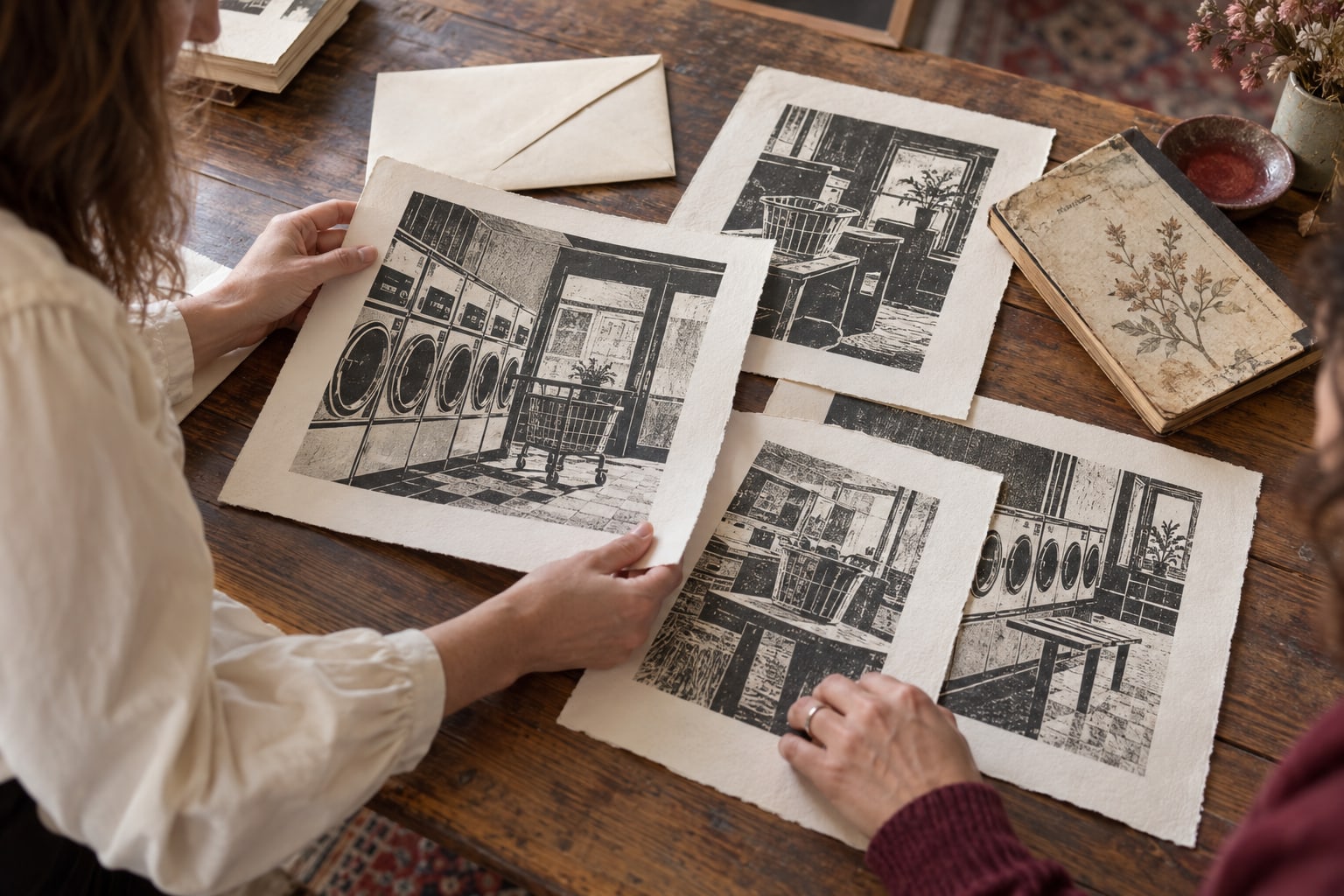
The morning filled with small discoveries. A receipt for the original press. A class photograph featuring Daniel in unfortunate shorts. A series of prints showing laundromat windows at night, each glowing with a different pattern of human waiting.
“These are extraordinary,” Nora said.
Mae held one toward the light. “She made those after moving to Milwaukee. Worked on them after her office job. She said people thought landscapes had to include trees.”
Nora looked at the clean, patient lines. “Could we show these at the café?”
“Reproductions. I want the originals assessed before they travel again.”
“Of course.”
Near noon, they found June’s class notebooks. Her lists were full of practical kindness: supplies provided, no fee for anyone between jobs, ask Mr. Bell if he needs a ride. They also contained years of planning in which Celia appeared mostly as someone who might visit.
Neither truth canceled the other. Nora felt the temptation to present the notebooks as a defense and chose instead to turn the next page.
Inside the cover of the final volume lay an unfinished letter.
Dear Celia, I have been trying to write something that makes me sound less selfish, which is probably how I got here.
Nora read no further until Mae had seen it. Then they sat together on the porch while the others continued inside.
June had written about enjoying being necessary. The classes had become a place where people looked to her, and she had allowed that attention to crowd out the partnership that made them possible. She had apologized, crossed out the apology, and written it again.
The letter ended mid-sentence. It was dated two years before Celia died.
“Did she send another version?” Nora asked.
“I don’t know.”
“I can look through the rest.”
Mae folded the paper carefully. “Yes. But I don’t need a final letter to make everything tidy. They were friends for forty years. Sometimes they failed each other. My grandmother knew both things.”
Nora looked at the garden, where late bees worked among the asters. “I keep thinking that if I make the studio good enough, I can fix something.”
“You can make a good studio,” Mae said. “That would be plenty.”
They ate lunch in the unfinished living room, using a door on trestles as a table. The conversation moved from old letters to current work. Mae described teaching a retired chef to adapt his kitchen after an injury. Priya discussed the café’s unreliable dishwasher with the gravity usually reserved for geopolitical crises.
Tess asked Nora what she wanted to make when no client was paying.
Nora glanced at the laundromat prints. “A series about rooms people choose. Kitchens after a difficult day. A library corner. Someone’s garden shed.”
“That sounds like an exhibition,” Priya said.
“It sounds like five drawings I might finish.”
“An exhibition can have five drawings. I own six chairs. We all begin somewhere.”
After lunch, Mae helped Nora select material for the café display. They wrote a short account of the print room, giving both founders their names, skills, and choices. The recovered sign would be represented in a photograph until it could be safely restored. The display would ask what a future studio might offer, rather than announcing a future Mae had not agreed to fund.
By four, the room was clear. Tess and Priya left. Mae went to meet the appraiser at the side gate, where they would inspect only the accessible areas. Nora washed mugs while Eli stacked the folding chairs.
From the window she could see Mae listening carefully, occasionally pointing toward the garden. Nora had spent much of her life thinking that a good collaborator anticipated everything another person wanted. Today had suggested a more useful definition: ask, listen, and leave enough space for an answer you had not prepared. She dried her hands slowly, deciding to try that with the man beside her before affection made the conversation easier to postpone.
“You were good with her,” he said.
“She’s easy to like when I stop trying to get the answer I want.”
“Useful discovery.”
Nora handed him a towel. “I’ve been thinking about us and work.”
He put the chair down. “All right.”
“I like you. Quite a lot. I also need to be able to disagree about a cabinet without wondering whether I’ve ruined dinner.”
His smile was brief and relieved. “I’ve been thinking the same thing.”
They agreed that work changes would stay in writing. Either could ask for another contractor if the overlap became uncomfortable. Dates would not become renovation meetings by default, and favors would be offered plainly, without invisible invoices.
“This is an unusually administrative courtship,” Nora said.
Eli took the mug from her hand and set it beside the sink. “We could make a less administrative minute.”
“We could.”
He kissed her, and she leaned into him with the growing ease of someone learning that wanting did not require surrendering judgment. Outside, a car door shut. They drew apart, smiling.
Mae stepped into the kitchen holding the appraiser’s card. She took in their expressions and raised an eyebrow.
“I can come back.”
“You can have coffee,” Nora said, feeling warm all the way to her ears.
Mae accepted the offer. Then she placed the card on the table.
“We’ll have the valuation next week. In the meantime, the property company increased its offer for my interest.”
Nora’s smile faded. Mae noticed and reached for the mug.
“I haven’t accepted,” she said. “But I need us to talk about an actual future, Nora. Soon.”