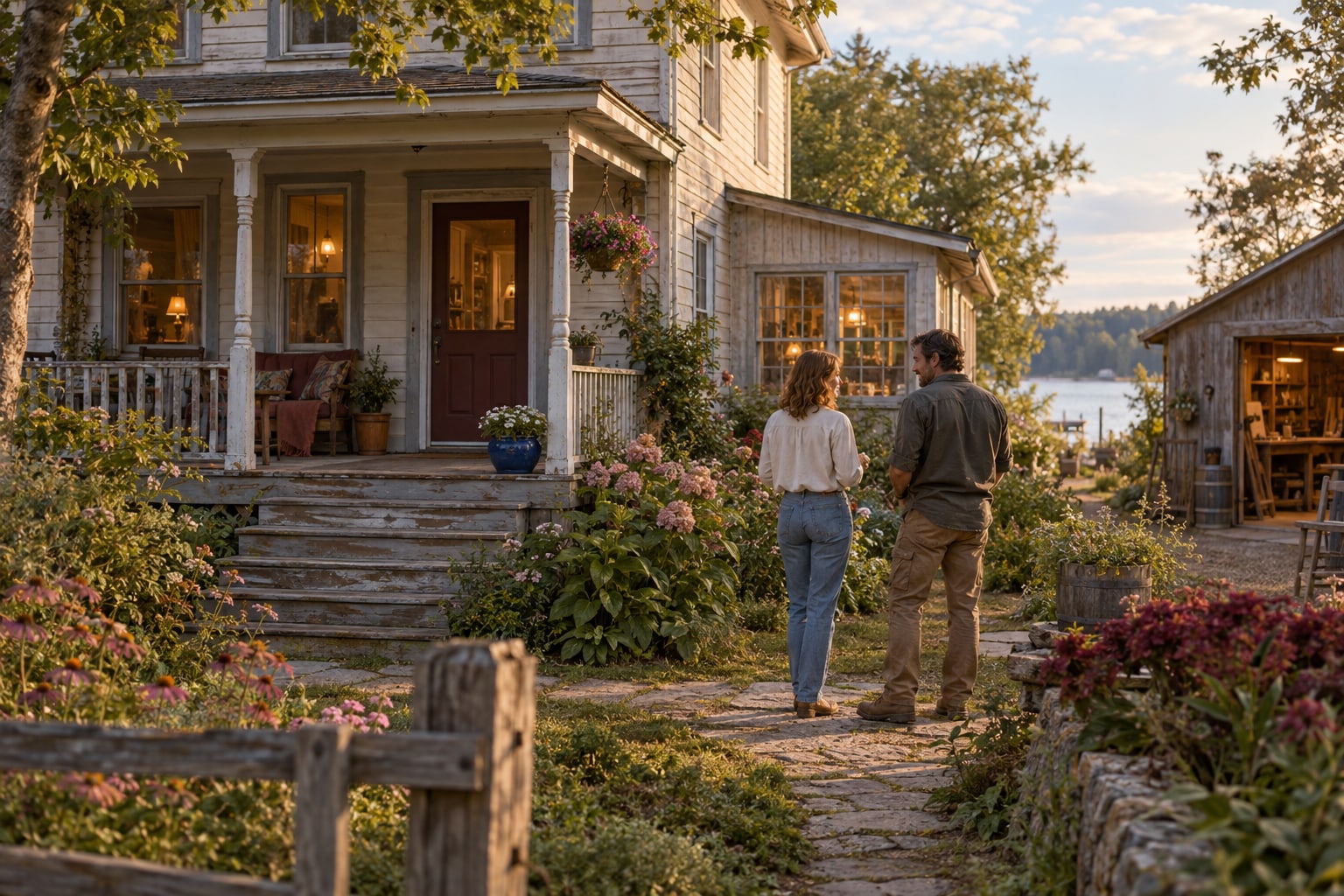
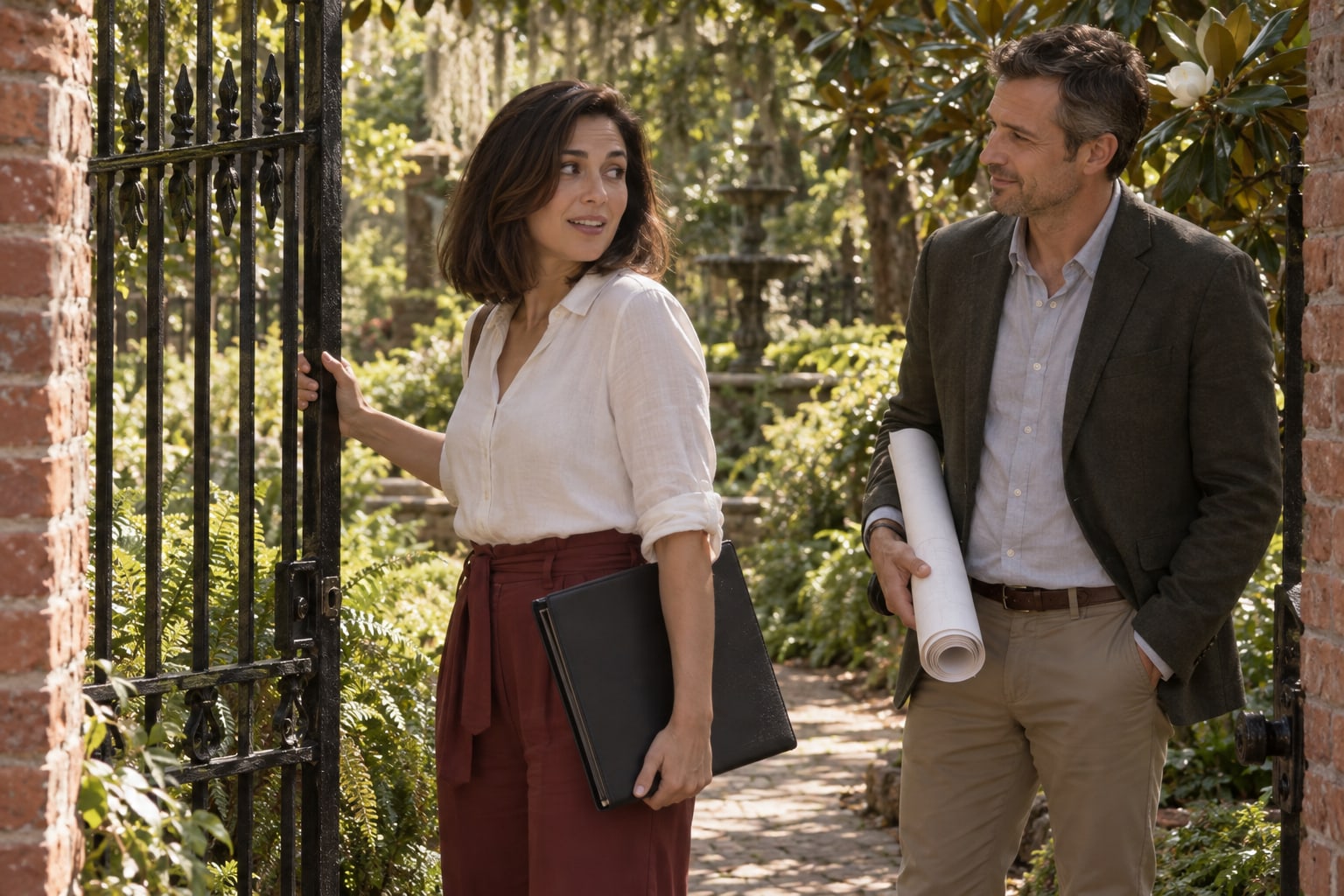
The garden gate stuck at exactly the place Lena remembered. You had to lift before you pushed, a small correction that made the difference between standing outside and going in.
She set her portfolio against the brick wall and tried again. Savannah's September heat settled around her shoulders. Somewhere beyond the fence, somebody was running water over gravel. Eighteen years had passed since she had last entered Wren Street Garden. The gate, apparently, had been pursuing other priorities.
“The hinge is being replaced Thursday,” a man said behind her.
She knew his voice before she turned. That seemed unfair. She had changed cities, careers, haircuts, the spelling people used when they addressed her professionally. Her body should have required a moment to consult its records.
Adam Whitaker stood on the sidewalk with a rolled drawing under his arm. His brown hair was shorter now, silver at the temples. There were lines beside his eyes that had not been there when she knew him. He looked at her as though he had expected this encounter and still failed to prepare.
“Lena.”
“Adam.”
He glanced at her portfolio, then the stubborn gate. “May I?”
She picked up the portfolio. “I remember how it works.”
“Of course.” He stepped back.
That small retreat unsettled her more than assistance would have. She had spent the flight from Chicago preparing for six weeks of family questions, the temporary apartment above Marisol's print shop, and a museum director who believed every exhibition needed an interactive screen. She had not prepared for the person who once knew exactly where she wanted to go.
She lifted. The gate opened.
Inside, the garden had grown both smaller and wilder. The magnolia still shaded the central walk. Ferns spilled beyond their brick borders. A new ramp curved toward the old conservatory, which now served as an education room. Along the far wall, a fountain stood dry beneath a handwritten notice requesting patience.
“You're here for the exhibition?” Adam asked.
Lena turned. “Please tell me you're delivering something.”
His expression shifted, a nearly invisible acceptance. “I'm the landscape architect.”
“Of course you are.”
“I found out you were the designer yesterday.”
She considered all the polite responses available to a woman of thirty-seven with an excellent professional reputation. “I found out about you approximately thirty seconds ago.”
“Then you should have been told sooner.”
She did not want him reasonable. Reasonable was difficult to get angry with in public.
Inside the conservatory, Evelyn Price, the garden director, waved both hands as if welcoming guests to a particularly successful surprise party. She wore yellow glasses and had arranged a plate of tiny cookies beside three substantial binders.
“Our dream team,” Evelyn said.
“We know each other,” Lena replied.
“Wonderful. That saves introductions.”
Adam pulled out the chair nearest the open window, then waited. Lena chose the chair opposite. He sat without comment.
The anniversary exhibition was called The Garden We Made. Thirty years of neighbors planting, pruning, raising money, arguing about benches, getting married, growing old. Lena would turn the archive into a walk through living memory. Adam would finish the accessible paths, restore the fountain, and build the new planting beds around her installations.
It was precisely the kind of work she wanted more of: physical, thoughtful, useful beyond the opening reception. In Chicago, she had spent a year designing an exhibition whose largest sponsor insisted its logo be visible from every entrance. Here she might let a visitor touch a rosemary bush while hearing the voice of the woman who had planted it.
She would not give that up because Adam Whitaker had acquired handsome hands and apparently learned to listen.
“I want the central path kept clear,” she said, laying her drawings on the table. “People need room to stop without becoming obstacles.”
Adam leaned forward. “The turning circles are marked here. We can shift the southern bed eighteen inches.”
“That costs you planting space.”
“It gives people somewhere to be.”
Their eyes met over the drawing. Once, years ago, they had been very good at making something together. A plan, a joke, a way through an impossible afternoon. She looked down first.
The meeting took an hour. Adam asked specific questions. He did not explain her work to her. When Evelyn suggested placing the childhood photographs above adult eye level, he waited until Lena answered instead of rescuing her point before she had made it.
By the end, Lena had a workable schedule and an unfamiliar ache behind her ribs.
Outside, she stopped beside the dry fountain. A flattened paper cup sat in the basin. Adam retrieved it and folded it into his pocket.
“I should have called when Evelyn told me,” he said.
“Yes.”
“I didn't know whether that would make coming here harder.”
Lena looked at the empty basin. “You could have let me decide.”
He was silent for a moment. “You're right.”
She hated that he seemed to mean it.
“We're going to work together,” she said. “I intend to do the work well. That's the entire arrangement.”
“All right.”
“Don't make this a chance encounter that repairs something.”
He held the rolled drawing against his thigh. “I won't.”
She left before he could say anything else she might carry upstairs with her.
Marisol Vega had prepared the apartment with clean sheets, a bowl of peaches, and the aggressive optimism of a woman who had known Lena since sixth grade.
“You saw him,” she said when Lena appeared in the print shop doorway.
“Did everybody know except me?”
“I knew he did garden work. I didn't know he did this garden work.” Marisol put down her ink roller. “Come here.”
Lena stepped into the hug reluctantly and then stayed there longer than intended.
“He's irritatingly normal,” she said against Marisol's shoulder.
“A terrible development.”
“He has opinions about wheelchair turning circles.”
“The monster.”
Lena laughed, and the laugh hurt enough to embarrass her.
Marisol drew back. “You can feel something and still keep your feet on the floor.”
“I don't know what I feel.”
“Then don't name it before supper.”
They ate takeout at the worktable while the shop cooled. Marisol talked about her divorce, which had become final in June, and the strange pleasure of buying an ugly green chair without consultation. Lena talked about Chicago and the promotion everyone assumed she wanted. Neither conversation required an immediate conclusion.
Upstairs, later, Lena unpacked her tools first. Pencils. Measuring tape. The small brass ruler her father had given her when she graduated. She placed his photograph beside the bed, then turned it slightly away from the window's glare.
Her phone lit with an email from Evelyn. Attached were the archive inventory and Adam's revised path drawing. He had moved the southern bed exactly as discussed. At the bottom of the message, beneath practical notes about drainage, he had written one sentence.
There is something of yours I still have, and I need to ask whether you want it back.
Lena read it twice. Outside, someone rolled a trash bin over uneven pavement. The ordinary sound continued while every part of the room seemed to wait.