
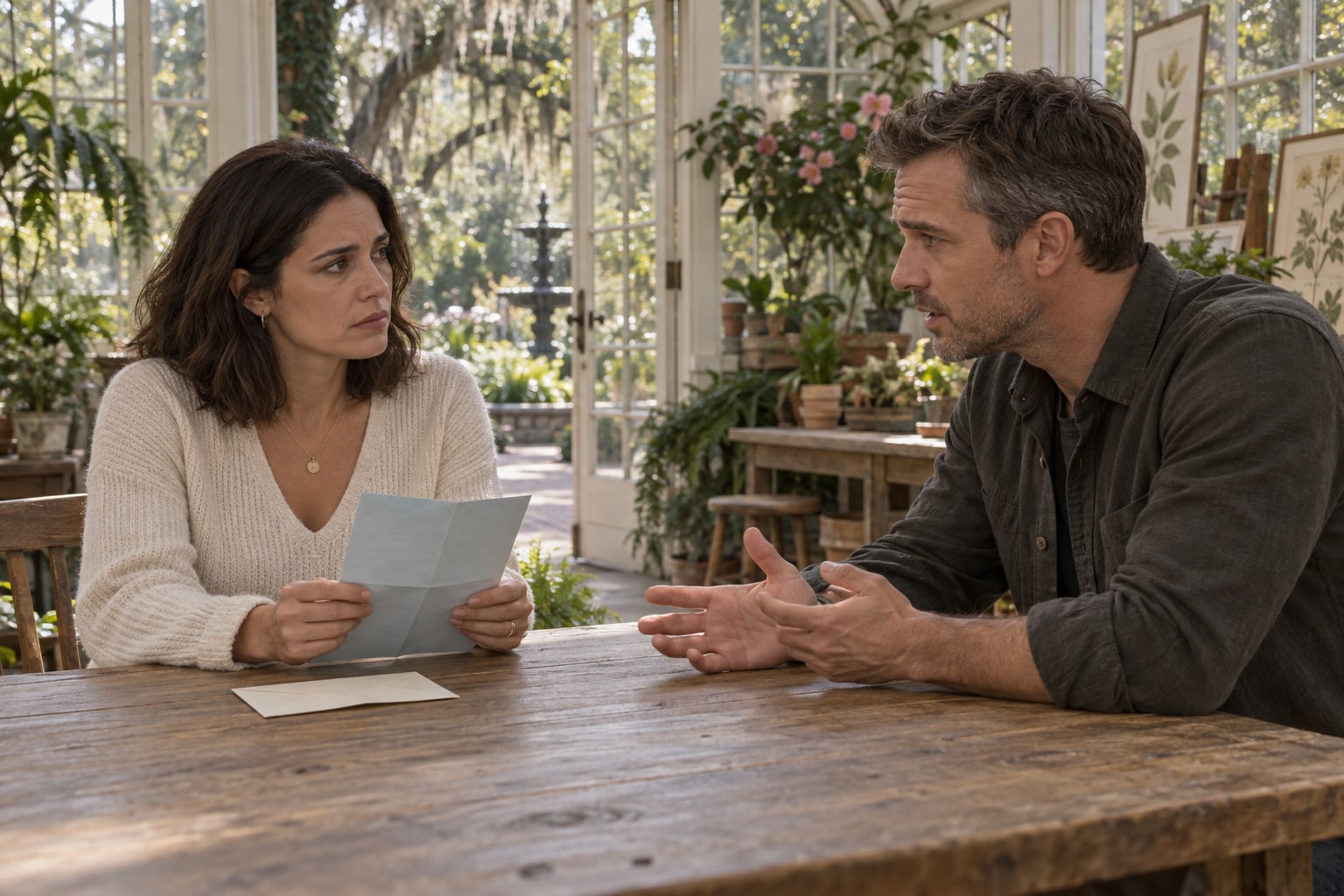
At eight fifty-eight, Adam stood outside the conservatory carrying a plain envelope. Lena had set two chairs on opposite sides of the worktable. She had removed the plate of cookies Evelyn kept replenishing. Nothing about this conversation needed refreshments.
“Come in,” she said.
He sat where she pointed and placed the envelope in front of her. Inside was the blue stationery she remembered, folded into thirds. Her nineteen-year-old handwriting leaned toward the right with a confidence she had not actually possessed.
Dear Adam.
She stopped after those two words.
“You received it the day before I left.”
“Yes.”
“You read it.”
“Yes.”
“Then tell me what happened.”
He kept his hands open on the table. “Dad had come home from the hospital that morning. My mother was frightened. Beth was twenty, in school, trying to come home every weekend. I had convinced myself that leaving the house for anything except work made me unreliable.”
“I didn't ask you to leave the house forever.”
“I know.”
“I asked you to meet me. Forty minutes. Maybe an hour.”
“I know what you asked.”
She pushed the letter a few inches away. “Don't agree with me so neatly that there's nowhere for the anger to go.”
His eyes lowered, then returned to hers. “I was afraid if I saw you, I would tell you I wanted to come. Or ask you to stay. I didn't trust myself to hear a third possibility.”
“So you chose silence.”
“Yes.”
“For both of us.”
“Yes.”
Outside, a delivery truck backed up somewhere on the street. Three clear beeps entered the room, absurdly ordinary.
“Afterward?” she asked. “The following week? The month after? You had my aunt's number. You knew which school.”
Adam swallowed. “At first I told myself contacting you would pull you backward. Later, I knew that was an excuse. I didn't want to explain that I had read something brave and answered it with nothing.”
There it was. Not a missing envelope, not an interfering parent, not a misunderstanding waiting to reveal their innocence. A choice, followed by enough smaller choices to build eighteen years.
“Your father recovered,” she said.
“Enough to manage at home. He needed help for years, but not every hour of mine. I made myself necessary in ways nobody asked me to.”
“And keeping this?”
He looked at the blue paper. “Sometimes I thought it proved I hadn't forgotten you. That was a comfortable thing to believe. Mostly it was something I couldn't bear to throw away and couldn't bear to answer.”
“It didn't belong in your life as evidence of how much you loved me.”
“No,” he said quietly. “It didn't.”
Lena stood. He remained seated, leaving her the height and the space.
“I thought I had asked for too much. For years, when somebody didn't call, I became reasonable before I became hurt. I told myself people were busy. I made my needs very convenient.”
Her voice shook. She hated that, then hated the instinct to apologize for it.
“I'm sorry,” Adam said. “For not coming. For not answering. For letting you carry questions I knew the answers to.”
She watched him. “What am I supposed to do with that?”
“Nothing today.”
“You don't get to make this dignified for me.”
“You're right.” His voice roughened for the first time. “I don't know how to say this without making another mistake. I don't want you to forgive me because we have a deadline together. I can have Hazel handle every coordination meeting. I'll work outside your hours if that helps.”
“That would make my job harder.”
“Then tell me what doesn't.”
She looked around the room, at the photographs waiting to become a story she could actually shape. “We work. We discuss the garden. You don't ask how I'm doing unless you can accept that the answer might be badly.”
“I can accept that.”
“And I keep the letter.”
“It's yours.”
He left without asking to touch her.
For several minutes, Lena remained standing. Then she sat and unfolded the paper completely.
I don't need you to know our whole future, she had written. I need you to talk to me about the next part. I can go and still love you. Those things do not have to cancel each other.
She pressed her hand against her mouth. What undid her was not how young she had been. It was how clearly she had understood something she later spent years doubting.
At noon, she walked to her mother's house instead of answering emails. Ruth Ortiz opened the door wearing gardening gloves and immediately removed them.
“Did somebody die?”
“No.” Lena's laugh escaped sideways. “No, Mama. I'm just having a terrible morning.”
Ruth moved aside. “Then I have rice.”
In the kitchen, beneath the clock her father had never repaired because its irregular chime amused him, Lena told her mother about the letter. Ruth listened without interrupting. When Lena finished, she folded a dish towel into an exact square.
“I wondered,” Ruth said.
Lena went still. “You knew?”
“No. I wondered why he never came to ask about you.”
“You told me leaving was what mattered.”
“It was what I knew how to protect.” Ruth touched the towel's edge. “I was afraid you would give up the scholarship. Your father and I had wanted things we never managed. Sometimes I made your leaving sound easier than it was because I needed you to go.”
“I needed you to know it hurt.”
Ruth's face changed. “I should have made room for that.”
They sat with the sentence until the refrigerator stopped humming.
“Did you hate him?” Lena asked.
“For a while. Then there were bills and your father's knees and ordinary life. Hatred requires a surprising amount of housekeeping.”
Lena laughed, properly this time.
That evening, she went back to the garden to collect her laptop. Adam was measuring a drain by the gate. He straightened when he saw her, then waited.
“I'm doing badly,” she said.
He nodded once. “Thank you for telling me.”
She did not thank him for listening. That was the minimum, and she was trying to remember the difference between a minimum and a miracle.
He moved his tools so she could reach the gate without stepping over them. She noticed because she was angry, because anger made every gesture a possible insult or argument. This one was merely useful. He returned to the drain, and she left carrying her own bag. Neither of them tried to make the moment stand for anything larger than the space he had cleared.
Upstairs later, she placed the old letter in a folder labeled Personal. Beside it lay the unfinished application she had brought from Chicago: a six-month design residency in Seattle, work she had wanted before anyone asked whether it was practical.
Lena opened the application. The first question asked what she was ready to make next.