The rain began while Lena was standing on a bench deciding whether an eight-year-old could read the new caption. She had borrowed a child's average eye height from a design guide, then distrusted it enough to conduct her own awkward experiment.
“You know most children stand on the ground,” Adam said from the path.
“I am representing a remarkably tall child.”
He looked at the paper sign. “The lower line catches the glare.”
“Exactly. Thank you.”
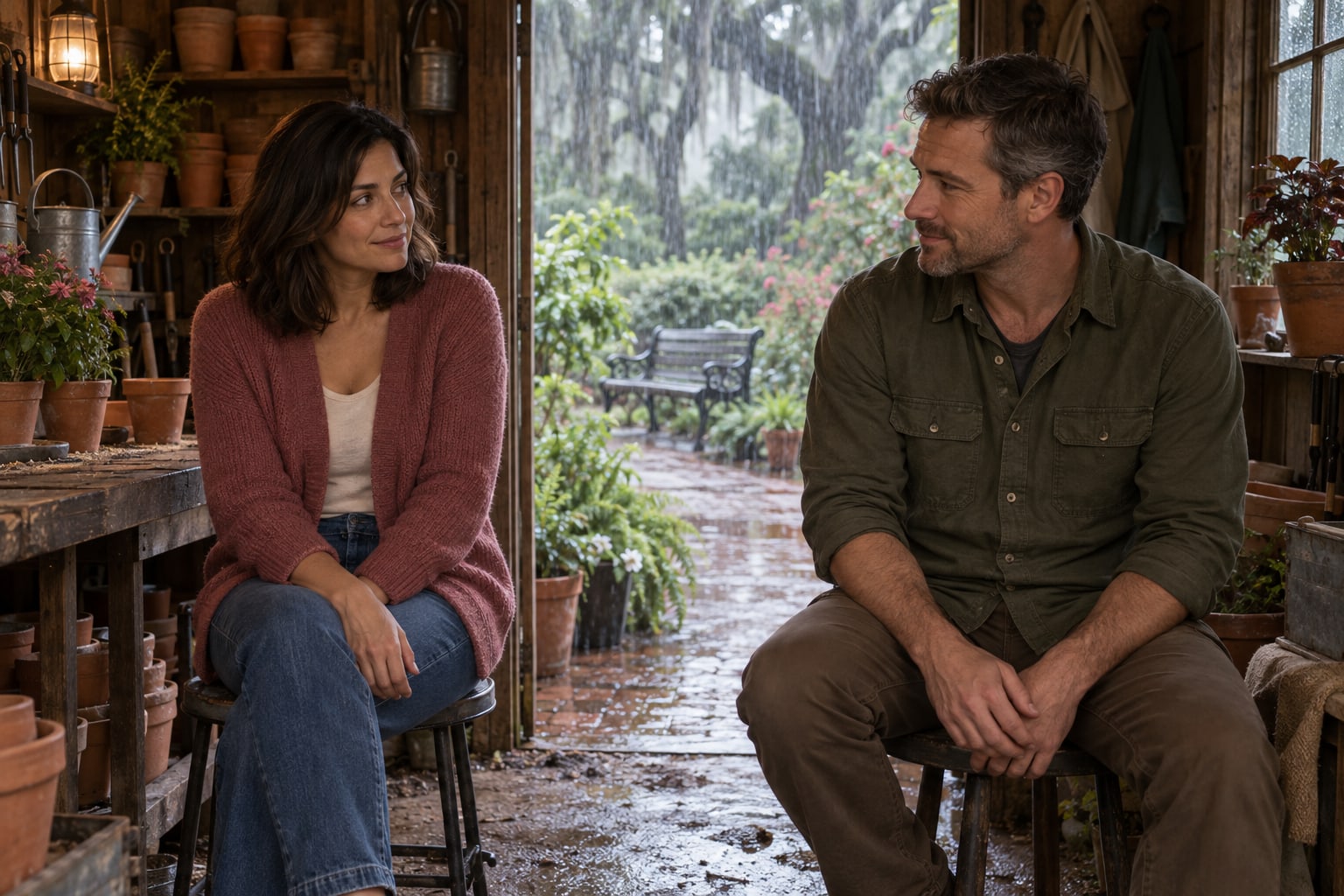
The first drops darkened the brick. By the time she climbed down, rain was striking the magnolia leaves with the determined sound of applause. Adam reached for the unsealed captions, and Lena gathered her swatches. They ran to the potting shed together, laughing only after the materials were safe.
The shed contained seed trays, a hose reel, and one narrow wooden bench. Lena took one end. Adam sat at the other, leaving a tray of empty pots between them like a chaperone with excellent posture.
“We could have gone to the conservatory,” she said.
“The nearest door was locked.”
“You have a key.”
He considered. “I made a poor strategic decision.”
She smiled despite herself.
For several minutes they watched the rain fill a shallow depression in the path. Adam frowned at it but did not stand. Lena appreciated his willingness to let drainage exist without immediately intervening.
“I applied for something,” she said.
He turned toward her. “What sort of something?”
“A design residency. Six months in Seattle. It starts in January.”
“What would you make?”
She had expected where would you live, what about your job, isn't Seattle expensive. The actual question opened a room inside her.
She told him about the traveling exhibition, the oral histories, the modular benches visitors could rearrange, the tactile maps that would let people understand a place without looking at it. He asked about materials. She asked whether a planter could travel between climates without turning into an act of botanical cruelty.
“Depends on the plant,” he said. “And who does the traveling.”
“I don't have it yet.”
“I know.”
“I may not get it.”
“It still sounds like work you want.”
Rain drummed on the roof. Lena looked down at her wet shoes.
“That was a good first question,” she said.
Adam's smile faded into something more careful. “I'm trying not to ask you things with the answer already hidden inside them.”
“Does that require practice?”
“Constantly.”
She watched a stream of water make its way along the shed threshold. “How did you learn?”
He took a breath. “Badly, at first. I had a relationship end five years ago. Claire said I was dependable about everything except telling her what I wanted. She was right.”
“Did you love her?”
“Yes. It wasn't enough to make us compatible. She wanted children, and I didn't. I kept hoping being good to her would turn that into a smaller difference.”
Lena nodded. The answer saddened her without threatening her. She did not need his intervening years to have been empty in order for theirs to matter.
“I went to a counselor afterward,” he said. “I thought I needed help with the breakup. Mostly I needed help learning that useful wasn't the same thing as known.”
She looked at him. “That's a hard distinction.”
“I'm still working on it.”
Lena had lived with a man in Chicago for three years. Ben was kind, funny, and certain every practical question could be answered with a spreadsheet. They had parted without betrayal when she realized she was describing the life she wanted in increasingly apologetic footnotes.
She told Adam that much. He listened without asking whether she had loved Ben more or less. The absence of competition felt unexpectedly intimate.
“I don't want children either,” she said after a while. “I like being the aunt who buys the loud present and goes home.”
Adam smiled. “Beth has opinions about that aunt.”
“Beth may file them with the appropriate department.”
“It's a very busy department.”
The rain softened. Neither moved.
“For the traveling exhibition,” Adam said, “you could use empty planters.”
Lena looked at him.
“Have each host grow something locally. The structure travels. What lives inside it belongs to the place.”
She reached for her pencil. “That solves three problems and gives me a fourth I actually like.”
“Which is?”
“Getting people to tell me why they chose what they chose.”
He smiled. “You seem good at that.”
She drew on the back of a spare caption while he watched the garden. It pleased her that he could offer an idea and let it become hers to examine. When she showed him the sketch, he asked about the removable panels. For five minutes, they discussed only the work, and the work made room for everything else.
Lena picked up an empty pot and turned it in her hands. “I keep trying to decide what the letter means now.”
Adam became still.
“I don't want it to be a test you pass by saying the right things,” she continued. “But I don't know how to stop watching you.”
“Maybe you shouldn't stop yet.”
She met his eyes.
“I can bear being watched,” he said. “I can't ask you to trust what I haven't done.”
The words were less comforting than a promise and more useful. She set the pot down between them.
“Would you have come?” she asked. “If I had called instead?”
His face tightened. “I don't know. But you shouldn't have needed to find the exact right way to ask.”
For eighteen years she had carried alternate versions of that morning: another envelope, another sentence, an earlier call. Something she could have changed to make herself easier to answer. Hearing him refuse those alternatives hurt like setting down a bag whose strap had cut into her hand.
She blinked hard. He waited, close enough to be present and far enough not to presume.
“I don't want you to touch me right now,” she said.
“All right.”
“I do want you to stay.”
“I can do that.”
They sat until the rain ended. A drop fell from the roof into a metal bucket with a bright, irregular note. Lena found herself breathing to its rhythm.
When they finally stepped outside, the garden smelled of wet brick and crushed leaves. Adam inspected the shallow pool and made a note for Hazel. Lena held the captions above the damp ground. They were still two people with work to finish. The fact comforted her.
At the gate, he said, “I'd like to have dinner with you.”
She stopped.
“Not to discuss the project,” he added. “And not because today means anything has been settled.”
Her first impulse was yes. Her second was to distrust the first.
“I need time to think.”
“Take it.”
She walked home under clearing branches, carrying captions that had stayed dry and a question she was finally allowed to answer at her own pace.