
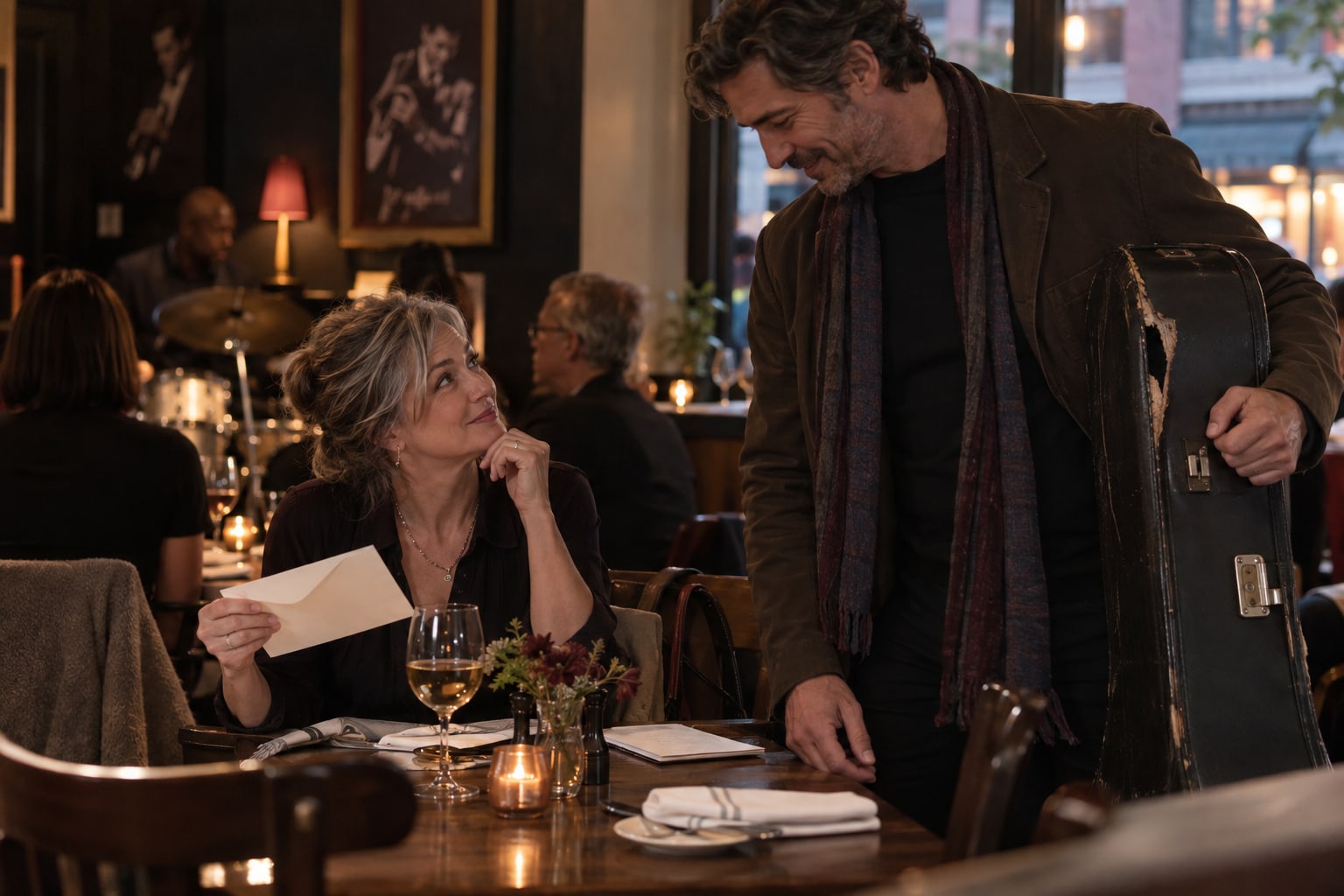
The man at Vivian Cross's table had ordered the wrong wine.
This was the first thing she noticed, which probably said something unflattering about her. The second was the instrument case leaning against his chair. The third was the folded white napkin he was using to stop the table from wobbling.
Her table had wobbled for eleven years. She had written movingly about other people's attention to detail and never done anything about it.
"I'm afraid this one is taken," she said.
He looked up. Dark eyes, silver threaded through dark hair, a small crease beside his mouth that suggested an expression already on its way. He wore a navy sweater with a repaired cuff. There was nothing apologetic about the way he occupied his chair, but he stood immediately.
"Then I've been misinformed."
"It isn't assigned. I just usually sit here."
"That's harder to argue with. Tradition."
Behind him, Leah emerged from the kitchen carrying a stack of menus and the particular look of a woman who had just remembered something expensive.
"Vivian. Thursday. I'm so sorry. The upstairs group arrived early, and I put Gabriel here while I sorted everything out. Give me two minutes."
Vivian should have said any table would do. On another evening she would have. Tonight she wanted the green chair by the window, the view of the bakery closing across the street, and a meal during which nobody used the phrase exciting next chapter.
An envelope containing twenty-four years of work reduced to six pages rested against her ribs inside her bag.
"Really, I can move," the man said.
When he reached for the instrument case, its handle came away in his hand.
For a moment they both looked at it.
"A persuasive exit," he said.
She laughed before she could stop herself. It was a small, startled sound. The first one she had made since the meeting with her editor.
"Is the instrument all right?"
"Perfectly. The case is making a statement about retirement."
"Everybody is, apparently."
His gaze rested on her face, attentive without sharpening. She had spent her working life noticing when people wanted a story from her. He seemed content to have heard a sentence.
Leah offered to put another place setting down. Vivian considered the room. Every other table held a couple or a family, except one beneath the speaker, where a man was explaining the concept of disruptive investment into his phone.
"Just while you eat," she told Gabriel.
"A conditional treaty. I accept."
He waited until she sat before settling opposite her. Vivian noticed that too, and disliked herself a little for noticing it as much as she did.
"You can have the window," he said. "I already looked out of it."
She took off her coat. "Anything worth seeing?"
"A woman carried a birthday cake very carefully for half a block, then balanced it on a mailbox to answer her phone. I was invested."
"Did the cake survive?"
"I believe so. We parted on hopeful terms."
The waiter arrived. Vivian ordered the roast chicken, the bitter greens, and a glass of the red Leah always kept for her. Gabriel asked for the fish. He didn't comment when she ordered dessert at the same time.
"You know what you want," he said after the waiter left.
"For dinner. It's an unusually manageable subject."
"I'll keep the conversation there."
"You don't have to be that careful."
He tipped his head. "Good. I was about to run out of opinions about potatoes."
Vivian put her bag on the empty chair beside her. The envelope slid halfway out. She pushed it back, but the newspaper's familiar blue masthead had already appeared.
He looked toward the window instead of at the papers.
That small courtesy unsettled her more than a question would have.
For twenty minutes they spoke about the neighborhood. Gabriel repaired stringed instruments three blocks away. He had played upstairs at Finch & Fork twice before, filling in for someone who was now moving to Oregon to raise goats.
"Is that a common progression for musicians?" she asked.
"More common than anyone tells you at the beginning."
He asked what she liked about this restaurant. It was an easy question. She began with the menu, the restraint of the kitchen, the fact that Leah understood acidity. Halfway through an explanation about salad dressing, she stopped.
"That sounded like work," he observed.
"It was a very good answer."
"I'm sure. I wondered if there was another one."
She looked at the bakery across the street. The lights were going off, one row at a time.
"They leave me alone when I want to be left alone," she said. "And they notice when I don't."
He nodded, accepting the answer without making it larger than she meant it to be.
Their food arrived. His wine was not wrong, she discovered when he offered her a taste in a clean glass. It was simply a choice she would not have made. There was probably a lesson in that. She decided not to pursue it.
Instead, she asked him how the handle had broken.
"I knew it needed replacing."
"And you repair things for a living."
"Other people's things. Those apparently deserve prompt attention."
His phone lit on the table. He glanced at the screen and silenced it.
"You can answer," she said.
"It can wait until I've finished dinner."
She was fifty-two. A man putting his phone away should not have felt like an event. Yet the room seemed to settle around them, the little candle no longer competing with the light of a screen.
When Leah brought Vivian's pear tart, she set down two spoons. Vivian raised an eyebrow.
"Habit," Leah said unconvincingly.
Gabriel left the second spoon where it was.
"You can have some," Vivian told him.
"I was hoping, but I didn't want to build my evening around an assumption."
"That's a surprisingly advanced skill."
"At fifty-five, one likes to have acquired something."
She smiled. He took one bite and closed his eyes briefly, not performing pleasure for anyone, simply paying attention to it. Vivian looked down at her plate.
The envelope was still beside her. Tomorrow she would calculate the numbers, speak to the adviser whose name Ruth had given her, and decide whether the newspaper's generous voluntary buyout was generous enough to build a different life on. She would think about insurance and savings and what happened to a person whose name had always appeared next to a job title.
For the first time that evening, she did not need to do any of that immediately.
Gabriel paid for his own dinner without attempting to claim hers. He slid his chair back.
"We're playing upstairs at eight. You're welcome to stay."
"I'm not much of a late-night person."
"Eight is only late if you sell breakfast."
"I have things to do."
"Then another time."
No wounded smile. No argument disguised as charm. He meant it.
She watched him improvise a strap for the case with help from Leah, then carry the instrument toward the stairs. At the first step, he turned.
"I'm Gabriel, by the way. We skipped that."
"Vivian."
"A pleasure to share your tradition, Vivian."
He disappeared upstairs.
She finished the tart. Put on her coat. Lifted the bag with its heavy white envelope. Outside, a bus hissed at the curb, and the familiar route home waited a short block away.
From the ceiling came three low notes, warm enough that she felt them in the table before she heard them clearly.
Vivian looked at the stairs.
There were things to do at home. None of them had asked her to stay.
She took off her coat again.
At the top of the stairs, Gabriel stood beside the little stage, adjusting a lamp. Surprise crossed his face when he saw her, followed by something quieter that she liked rather more.
"Vivian Cross," she said, holding out her hand. "Since we were introducing ourselves properly."
His hand was warm around hers.
"Then I'm very glad you came back, Vivian Cross."