There was one empty chair in the front row and three near the back. Vivian chose the back.
It was an old professional habit: never sit where the room could make demands on you. From here she could see the stage, the narrow bar, and the stairs. She could leave without having to explain that a pleasant evening had become unexpectedly difficult.
Gabriel noticed her choice. He gave her a brief smile and went back to checking something with the pianist.
The room above Finch & Fork had probably once been somebody's apartment. A shallow fireplace held a vase of branches. Books stood on a shelf beside the bar, and the chairs did not match. Vivian had eaten downstairs for eleven years and come up here exactly twice, both times for professional events where everyone had spoken too loudly about the importance of community.
Tonight, people were simply finding places to sit.
A woman in a burgundy jacket asked whether the seat beside Vivian was free. When Vivian said yes, the woman sat with a grateful sigh and took off a pair of conspicuously uncomfortable shoes.
"Nobody tell the music," she murmured.
Vivian smiled. She put her bag under her chair, pushing the newspaper's envelope out of sight.
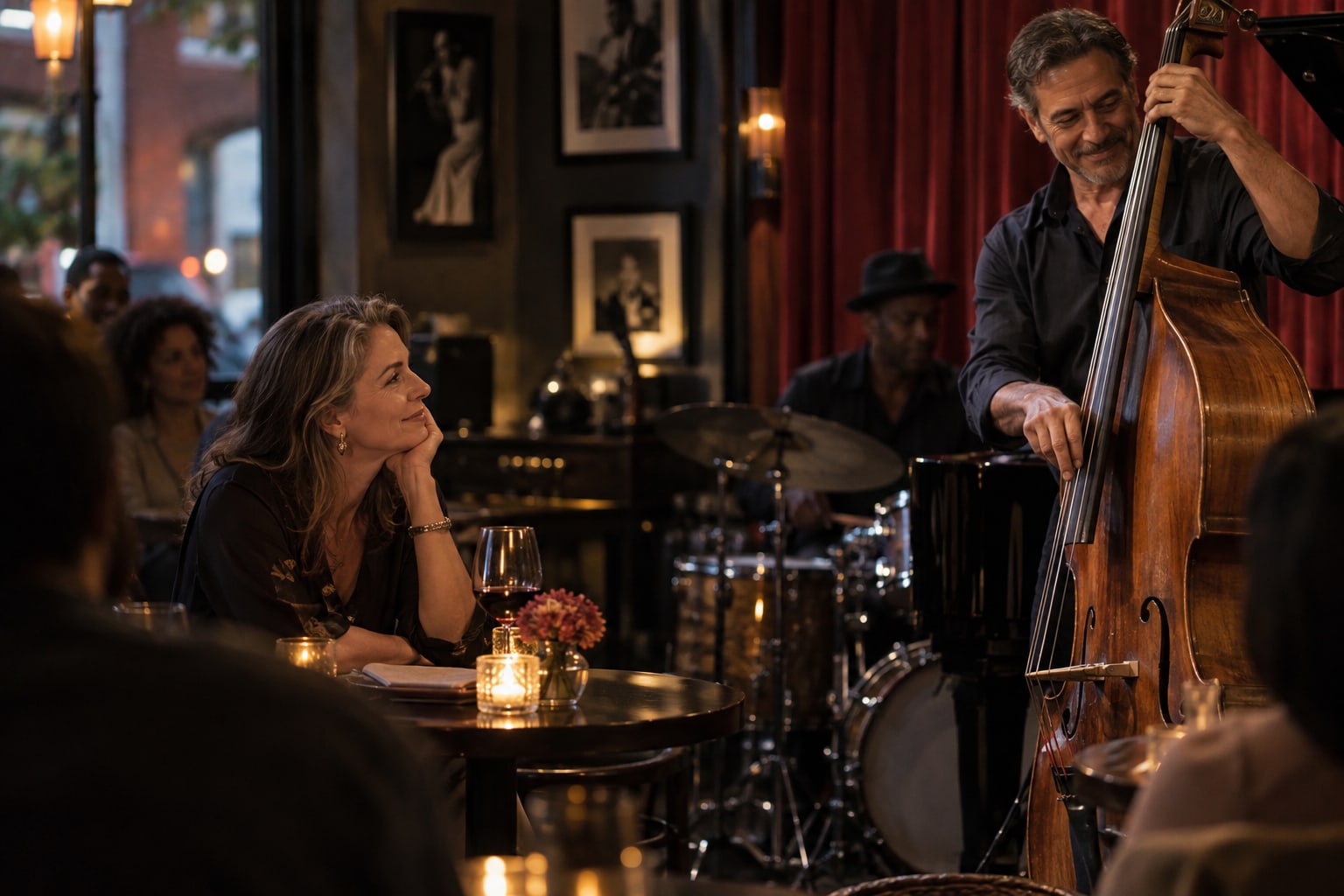
Gabriel lifted the bass into place. Beside the instrument, he looked both more familiar and less so. The easy man who had teased her about potatoes had become still, listening to the pianist play a few notes. When he answered them, the sound seemed to arrive from somewhere beneath ordinary conversation.
She had forgotten that listening could be an activity of its own.
Not listening for a useful quote. Not deciding what she would say next. Simply letting somebody else choose the pace for a while.
The first piece was lively. The woman beside her tapped one bare foot beneath the chair. Halfway through, the drummer missed something and laughed; the pianist responded with a little flourish that made Gabriel grin. Their pleasure in one another was visible. It wasn't flawless, and it wasn't pretending to be.
Vivian felt her shoulders loosen.
The second piece began softly. Gabriel looked toward the back of the room once. She could have been imagining the pause when his eyes met hers. She was old enough to know how often a woman could make a whole conversation out of a glance.
She was also old enough to enjoy one without putting it on trial.
At the break, he came over carrying two glasses of water. He offered one rather than setting it in front of her.
"You said you had things to do."
"I still do. They seem to be managing without me."
"A discovery worth protecting."
The woman in burgundy retrieved her shoes and excused herself to the bar with an expression that was almost, but not quite, discreet.
Gabriel took her chair after Vivian nodded toward it.
"I know your work," he said.
There it was. Vivian prepared the small pleasant smile she used when someone wanted to explain a grievance involving a restaurant she had reviewed eight years earlier.
"I thought you might."
"You wrote about that bakery on Eighth Street. The one that opened before dawn because the owner said night workers deserved fresh bread too."
She looked at him properly. "That was years ago."
"I kept going there after reading it. It was a good place to finish a late shift."
"Most people remember the restaurants I didn't like."
"Well, I have plenty of things I don't like already. No need to borrow yours."
She laughed. He rested his glass on his knee.
"Does being recognized make this awkward?"
"It depends what comes next."
"I was going to ask whether you wanted another chair. The one you're in has a ridge across the back. I know because I sat through somebody's entire birthday speech in it."
She had been shifting away from the ridge for twenty minutes.
"That," she said, "would be excellent."
He traded her chair for the empty one beside the wall without turning it into an undertaking. When he returned, he did not ask her about the paper. He told her the drummer's name was Owen and that the pianist, Elaine, had known him long enough to be unimpressed by almost everything he did.
"That seems healthy."
"It's extremely inconvenient."
Elaine called him back to the stage. He rose, then hesitated.
"I won't play a song at you," he said.
"At me?"
"People think a public dedication is romantic. Sometimes it just makes someone responsible for responding correctly."
Vivian watched his face. "And here I had my response prepared."
"Save it. Could be useful if someone proposes a toast."
The second set passed more quickly than the first. At the end, Vivian clapped until her palms warmed. Gabriel bowed his head toward the room, then looked back at his friends, sharing whatever the evening had given them.
She waited while he packed up. The burgundy-jacket woman gave her a quiet goodnight and left without offering advice. Vivian appreciated her enormously.
At the stairs, Gabriel asked which way she was going.
"South, then west."
"I'm north. I can walk you to the corner."
"I do know the neighborhood."
"I assumed. I wanted another two minutes of your company."
There was nothing elaborate in the answer. It reached her anyway.
Outside, the pavement shone beneath the streetlights. Somewhere a delivery driver was arguing cheerfully with a restaurant cook about basketball. Gabriel walked beside her, the improvised strap of his case over one shoulder.
"I'd like to see you again," he said when they reached the corner. "Without accidentally occupying your furniture."
Vivian looked at the crossing signal. "For dinner?"
"Or a walk on Sunday. There's less pressure to have an opinion about the dressing."
She could have told him she was busy. The words were ready, worn smooth by use. Busy was an efficient answer. It protected the person hearing it from embarrassment and the person saying it from almost everything else.
Instead, she took out her phone.
"Sunday afternoon. A walk."
He gave her his number. When she sent him her name, his phone lit. He looked at it, then at her.
"Goodnight, Vivian."
"Goodnight, Gabriel."
He waited for the crossing signal to change, not holding her back, and went in the other direction when she crossed.
At home, she put the envelope on her desk. Beside it stood a photograph of Daniel on a windy beach, one hand raised against the camera. He had hated that picture. She loved it because he was about to laugh.
Her phone vibrated.
Gabriel: Sunday at two? River entrance by the museum. I'll leave the furniture where it is.
She smiled, then felt the smile falter as she looked at the photograph.
Four years was a long time. Four years was no time at all. Both could be true, which was an exhausting way for time to behave.
The next morning, Ruth listened to the whole story over coffee without interrupting. This required such obvious effort that Vivian finally said, "You can say whatever it is."
"I was going to ask if he's handsome."
"You were not."
"I was also going to ask if you enjoyed yourself. Women our age are allowed more than one question."
Vivian turned her cup in its saucer.
"I enjoyed myself. Then I came home and saw Daniel's photograph."
Ruth put down her spoon. "The photograph will still be there on Sunday night."
"I know."
"Do you?"
Vivian looked through the café window. A man outside was trying to fold a newspaper in the wind, failing, and trying again.
She picked up her phone.
Sunday at two, she wrote. I would like that.