
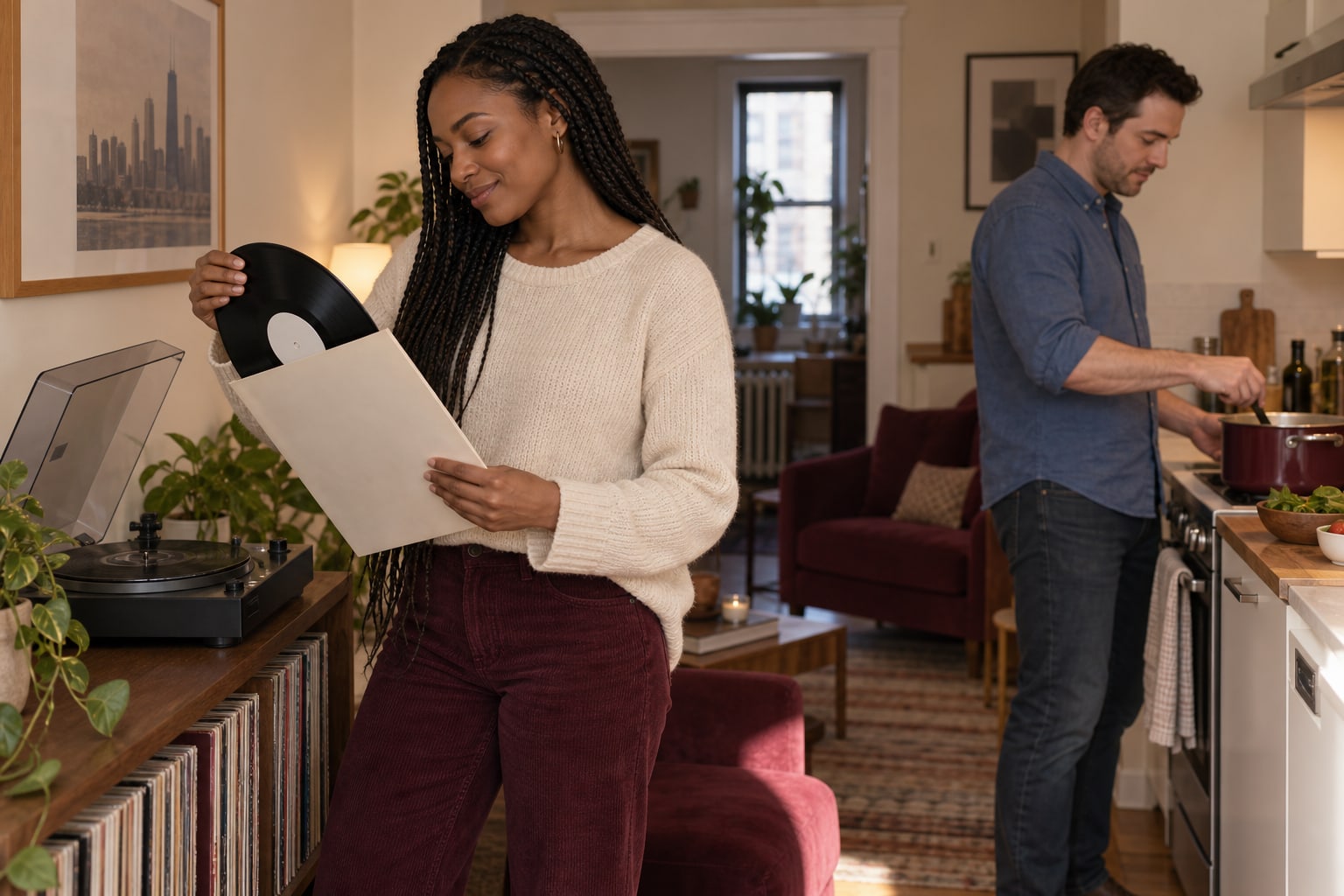
Lucas had cleaned his apartment until it looked as if nobody with a body had ever lived there.
He realized the mistake when Dev arrived to return a borrowed drill and stood in the doorway, surveying the bare coffee table.
“Did you get robbed by a very considerate person?”
“I have a date.”
“With a health inspector?”
Lucas took the drill. “You can leave now.”
Dev spotted the cookbook propped against the toaster. “You’re making the lemon thing.”
“Chicken.”
“That’s the one. Don’t keep opening the oven because you’re nervous.”
“I’m not nervous.”
Dev looked at the polished sink, then at him.
“Sure.”
After his friend left, Lucas put two books back on the coffee table and abandoned a third because arranging evidence of personality felt worse than cleaning it away. He liked Maya. The simplicity of that fact had begun causing complicated behavior.
He checked the table again, then made himself sit down for five minutes. From the neighboring apartment came the sound of somebody practicing a difficult passage on a violin, getting it wrong, and starting over. Lucas listened until the player found the phrase. He had no idea who lived there. He hoped they knew someone had enjoyed the attempt as much as the result. Then his timer sounded, and he went to check the chicken without opening the oven door.
She arrived at seven carrying flowers and a bottle of sparkling apple juice.
“I didn’t know what you drink before another shift,” she said.
“I’m off tonight.”
“Then consider it a sophisticated tribute to apples.”
Her braids were gathered high, and she wore a green dress beneath a denim jacket. Lucas forgot the next useful sentence.
She tilted her head. “Is the chicken burning?”
“You look beautiful.”
Her expression changed before she covered it with a smile. “That’s a much better explanation.”
He took the flowers, kissed her cheek when she leaned toward him, and showed her where to put her coat.
Maya noticed the record player first. Then the photograph of Lucas and his sister Jo standing on a dock beside their father, all three squinting into sunlight.
“You have his smile,” she said.
“He claims I stole it.”
“A plausible allegation.”
She wandered to the books and picked up a battered mystery novel. “I read this on a train and missed my stop.”
“The ending?”
“Don’t tell me you guessed it.”
“I didn’t. I blamed a completely innocent gardener.”
“Then we can continue.”
Dinner worked. This seemed miraculous despite the fact that Lucas cooked regularly and had followed an ordinary recipe. Maya helped carry plates to the small table by the window. He let her. It took an actual decision to stop saying he could get everything.
They talked about an old soul record she had chosen and whether a person could legitimately dislike a song everyone else loved. Maya argued for the right to private musical dissent. Lucas made her defend two examples, then declared one position indefensible.
“I thought these were honest dates.”
“Honesty doesn’t eliminate consequences.”
She laughed, and the apartment began feeling inhabited again.
After dinner they washed dishes together, she drying, he washing. Maya told him she had signed the development agreement that afternoon.
“Congratulations,” he said, turning off the tap so he could hear her properly.
She looked pleased, then guarded. “I negotiated the title and control over the final episodes. They’re paying for development now, then deciding on full production.”
“That sounds like movement.”
“It is. There’s a clause allowing promotion with development materials. I asked Evan to confirm they’ll clear participant uses with me.”
“Did he?”
“He said they always do.”
Lucas dried his hands. He could hear the thin place in the sentence because she could hear it too. But he was not her lawyer, supervisor, or conscience, and she had not invited an evaluation.
“How do you feel about it?” he asked.
“Excited. A little sick. Like I’ve stepped onto a moving walkway and need to learn its speed.”
“You can still decide where you’re going.”
She considered that, then nudged his shoulder with hers. “Put on another record.”
They sat on the sofa with the window cracked open. Outside, someone was teaching a child to ride a bicycle along the sidewalk, their encouragement traveling upward in short bursts. Maya tucked one leg beneath her. Her bare foot rested near Lucas’s knee.
“My turn for a question,” he said. “What do you do when you’re not making things?”
“This is a hostile question.”
“I suspected.”
“I have friends. I cook. I read three pages of a book before remembering an email.”
“All three pages?”
“On vacation.”
He smiled. “What would you do if nobody needed anything from you for a day?”
She looked toward the window, actually thinking. “Take the train somewhere with no useful reason. Get off because I liked the name of a stop. Eat something I can’t justify nutritionally. Maybe dance.”
“You dance?”
“Competently, in flattering light.”
Lucas stood and held out his hand.
“That is an alarming level of confidence,” she said.
“The lamp’s dim.”
She took his hand.
There was barely room between the sofa and table. They moved the table together, laughing when one leg caught the rug. Then he settled a hand at her waist, and she rested hers on his shoulder, and the small living room became sufficient.
He was not a brilliant dancer. Maya appeared delighted to discover it.
“You lead like you’re directing traffic.”
“Clear communication saves lives.”
“It can also threaten toes.”
He adjusted, listening through his hands. She drew closer. By the end of the song, the joke had softened into a silence that felt chosen.
“Kiss me,” she said.
He did. He held her steadily while she curled her fingers into his shirt, and the relief of being welcomed nearly undid his practiced calm. When she smiled against his mouth, he smiled too.
They returned to the sofa, her hand resting in his. Neither tried to turn the evening into something they had not discussed. The closeness was already a great deal.
At ten, Maya reluctantly reached for her coat. “Early interview.”
“I’ll walk you down.”
She stopped beside the coffee table and picked up the mystery novel.
“Can I borrow this? I want to see whether the clues were actually there.”
“Of course.”
“I’ll bring it back.”
Lucas heard the promise as more than library etiquette and tried not to show too much of that on his face.
At her car, she kissed him goodbye without waiting for him to ask.
“Third date,” she said. “Strong kitchen performance. Developing footwork.”
“I appreciate the balanced review.”
He watched her drive away, then returned upstairs to two glasses by the sink and the warm disorder of company. His phone showed three missed messages from Jo about Friday’s appointment.
The first asked whether he could take their father. The second said she was checking another option. The third said not to worry; she had handled it.
Lucas stared at the final message about the following Friday longer than it deserved.
Then he typed, What does handled mean?