
By the following Saturday, Maya had become the owner of two concert tickets, a production budget, and an uneasy feeling about the phrase emotional access.
“People connect with vulnerability,” Evan said, standing beside the edit suite while she cut an interview with Leon.
“People also connect with a good joke.”
“I’m not asking for misery.”
“You asked whether he could talk about missing his daughter’s graduation.”
“He mentioned it in the transcript.”
“To explain why he changed employers ten years ago. He isn’t a symbol of sacrificed fatherhood. He’s a man who likes his current job.”
Evan sat on the edge of the neighboring desk. He was not a bad editor. That made these conversations harder. He could find a story’s spine in a heap of unrelated observations. He could also mistake a familiar shape for a necessary one.
“You need to bring the audience in,” he said.
“Then let me use the bit where he ranks office plants by how dramatic they are.”
Evan sighed. “Play it.”
Three minutes later, he laughed despite himself.
Maya pointed at him. “Emotional access.”
“Fine. Keep the plants.”
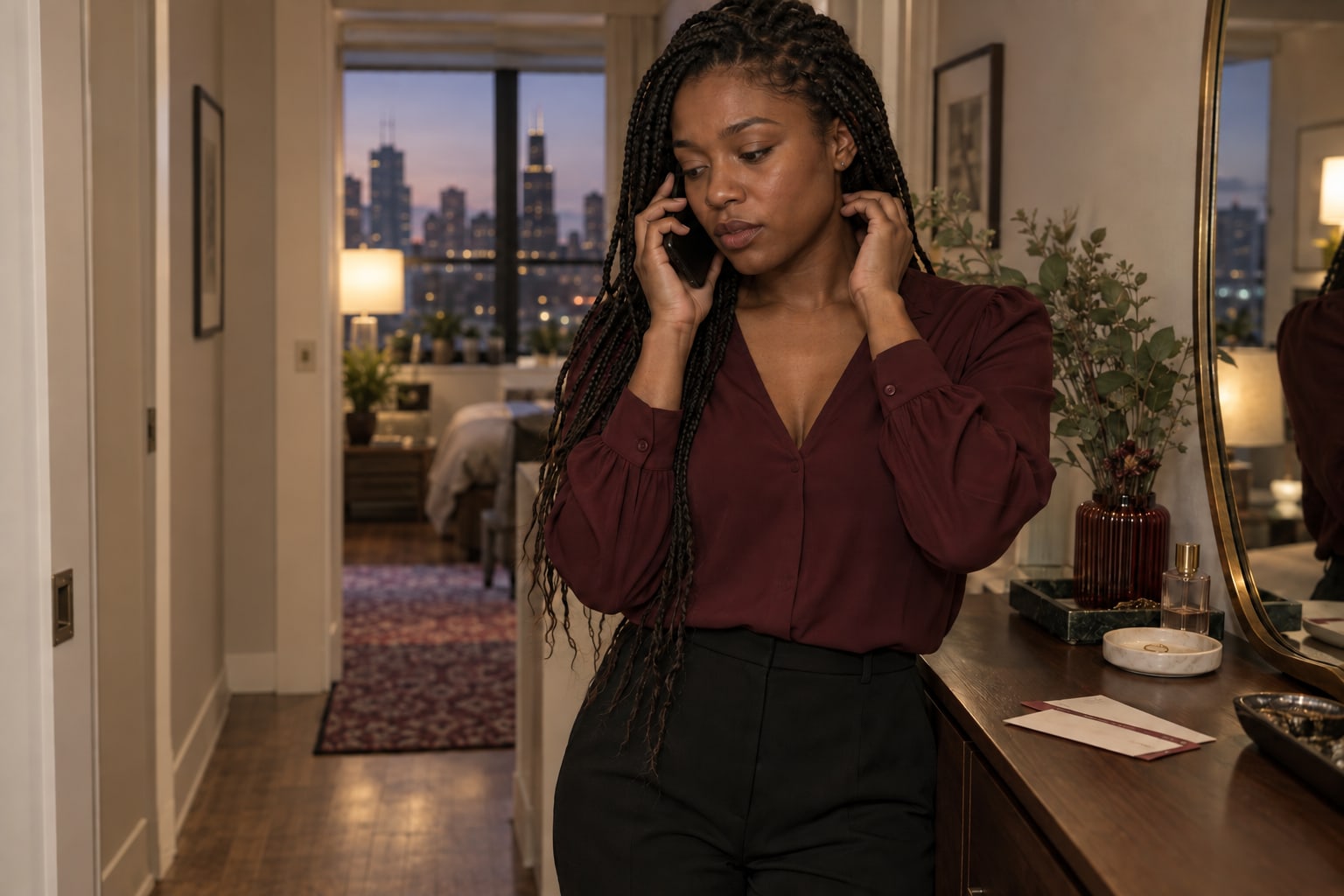
She was still pleased with that small victory when Lucas called at five thirty.
“I can’t make tonight,” he said.
She was standing in her bedroom wearing one earring, the other caught in the lining of her makeup bag.
“Everything okay?”
“Something with my dad. I need to go over there.”
“Is he all right?”
“I don’t know yet.”
She stopped searching. “Okay. Tell me when you know.”
“Yeah. Sorry.”
The call ended before she could say anything else.
Lucas’s neighbor had called because Frank’s front door was unlocked and he had not answered his phone. The sensible explanations existed. Frank might be outside. He might have gone with a friend. He might, as he often did, have left his phone beside the toaster while explaining that modern devices were too demanding.
Lucas knew all of that and drove over anyway.
He called Jo twice. She was at a movie with her partner, which he knew because she had told him that morning. When she texted during a break, he answered with the clipped efficiency he used when he was frightened and pretending he was simply busy.
Dad isn’t answering. Heading over.
Her reply came immediately. He’s with Walter. Record fair. Remember?
Lucas did not remember.
He remembered discussing the turntable. He remembered Frank saying something about finding the album he used to own. He remembered himself checking his schedule while his father was still speaking.
By then he was three blocks from the house.
Frank returned at six twenty carrying records and arguing cheerfully with Walter about a trumpet player. He stopped when he saw Lucas on the front step.
“What happened?” Frank asked.
“Your door was open. Your phone—”
“Was charging.”
“You can’t just leave it.”
Frank’s expression settled. “Watch your tone.”
Walter, displaying a lifetime of social judgment, announced he needed to put his purchases in the car.
Lucas rubbed his forehead. “I thought something happened.”
“Something did happen. I bought records.”
“Dad.”
“You think I don’t know what you’re afraid of?” Frank’s voice softened without becoming less firm. “I live in this body. But I told you where I was going.”
Lucas looked at the paper sleeve under his father’s arm. A corner had bent on the journey. His alarm began turning into embarrassment, which was somehow harder to carry.
“The neighbor called.”
“Then next time she can call Walter. Or you can remember I have friends.”
Inside, Frank made tea. Lucas stayed to examine a sticking latch that Frank had not asked him to examine. Then he adjusted a speaker cable. Then he made a list of household jobs that, by seven thirty, began looking suspiciously like reasons not to admit he had overreacted.
His phone lit with Maya’s message.
Any news? Hope your dad is okay.
He wrote, He’s fine. Dealing with things here.
The words were true in the least useful way.
Maya read them while Renée sat on her sofa fastening an ankle boot. Renée had cheerfully claimed the spare concert ticket and arrived with enough snacks to suggest an overnight journey.
“He’s okay,” Maya said.
“Good.”
She looked at the message again. She had not expected Lucas to choose a date over his father. She had expected, after three dates and a clear agreement, something more than dealing with things.
“You look disappointed,” Renée said.
“I’m allowed to be disappointed and understanding simultaneously.”
“Of course. Human beings can operate two tabs.”
Maya found the missing earring in her sleeve. “I just don’t want to turn into the woman waiting by a phone because someone decided his life is too complicated to explain.”
“Then don’t. You’re going to a concert with a highly desirable librarian.”
“You aren’t a librarian.”
“Program manager has less romantic mystery.”
The show was good. A singer in a white suit held the room with a voice that seemed to understand every bad decision anyone had made since eighteen. Maya danced beside her friend and thought about Lucas only between songs, which counted as progress.
During a familiar chorus, Renée took both Maya’s hands and spun her half a turn. Maya nearly collided with a man carrying two carefully protected drinks. He rescued them, bowed, and went on his way. The room felt generous. People made space, forgave clumsy feet, sang the words they remembered and invented the rest. Maya let the music have her attention. Whatever happened tomorrow, she did not intend to miss a good night already happening around her.
At ten forty-five, outside the venue, she finally wrote back.
Glad he’s fine. I would have appreciated a little more information once you knew. We can talk tomorrow.
Then she put the phone away and let Renée talk her into fries.
Lucas read the message in his own kitchen. He had left Frank’s after his father said, kindly but unmistakably, “Go have a life that contains more than this house.”
Jo had called on his drive home.
“You don’t get extra love for being first to worry,” she said.
“That’s not what I’m doing.”
“Sometimes it is.”
He had disliked the sentence enough to know he should think about it.
Now Maya’s message waited on the screen, calm and disappointed. He began typing an explanation of the neighbor, the unlocked door, the way a quiet house could throw him years backward. Then he deleted it. It sounded like a defense because he wanted it to function as one.
He could say he had been scared. He could also say that once the fear passed, he had remained unavailable by choice.
Those were harder sentences.
He wrote, You’re right. I’m sorry. Can I call tomorrow at eleven?
Her answer arrived several minutes later.
Eleven works.
No heart, no small joke. He had not earned either tonight.
Lucas set the phone down and looked at the empty place on his coffee table where Maya’s borrowed book had been.
For the first time since meeting her, he wondered whether wanting someone back would be enough to stop him making it difficult for her to return.